


Cornice
Altre immagini
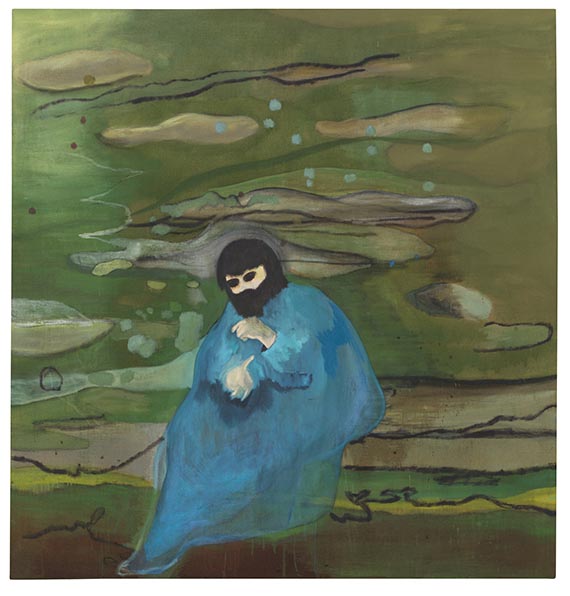
32
Peter Doig
By a River, 2004.
Olio su tela
Stima: € 1,500,000 / $ 1,680,000
32
Peter Doig
By a River, 2004.
Olio su tela
Stima: € 1,500,000 / $ 1,680,000
Peter Doig
1959
By a River. 2004.
Oil on canvas.
Inscribed with the work number “PD/M 71” on the stretcher. 200 x 186 cm (78.7 x 73.2 in). [JS].
• MASTERPIECE Peter Doig, international superstar of contemporary figurative art.
• MONUMENTAL Characteristic motif of the solitary figure in a large format.
• ICONIC The solitary thinker as a symbol of intellectual creativity.
• RARITY The first large-format Doig painting on the German auction market.
• DATE OF CREATION From the same creative period as Doig’s iconic painting “100 Years Ago (Carrera)” (Centre Pompidou, Paris).
• MUSEUM-QUALITY: Large-format paintings are held by important museums and private collections worldwide, including MoMA, New York, and the Tate Modern, London.
• PROVENANCE: Part of a major German private collection of important international contemporary art since its creation.
We are grateful to Contemporary Fine Arts, Berlin, for the kind assistance.
PROVENANCE: Contemporary Fine Arts, Berlin (directly from the artist; with a label on the stretcher).
Private collection, Germany (acquired from the above in 2004).
EXHIBITION: Peter Doig – Metropolitain, Pinakothek der Moderne, Munich, and Kestnergesellschaft, Hanover, May–September 2004, cat. no. 31, no page (illustrated, with the label of the Kestnergesellschaft on the stretcher).
54th Carnegie International, Carnegie Museum of Art, Pittsburgh, October 2004–March 2005, p. 228 (in the text).
Essential Painting, The National Museum of Art, Osaka, October–December 2006, p. 55 (illustrated, on the stretcher with the label).
Peter Doig. No Foreign Lands, Scottish National Gallery, Edinburgh, Montreal Museum of Fine Arts, Montreal, August 2013–June 2014, p. 137 (illustrated).
LITERATURE: Adrian Searle, Kitty Scott, and Catherine Grenier, Peter Doig, London 2007, p. 39 (illustrated on p. 32).
Richard Shiff and Catherine Lampert, Peter Doig, New York 2011, p. 117 (illustrated).
"Much like the movie theater—one of the last sanctuaries of undisturbed solitude—Doig’s images ultimately take the viewer into solitude and can spark a fruitful exploration of one’s own ideas. If his paintings are meant to achieve anything at all, it is perhaps this: to perceive the experience of being stranded in a foreign place and the feeling of solitude not as a threat to life, but as an opportunity for growth [..]"
Bernhart Schwenk, Grüße aus Carrera. Aus der Weite der eigenen Einsamkeit. In: Peter Doig – Metropolitain, exhibition catalog, Pinakothek der Moderne, Munich / Kestnergesellschaft, Hanover, Berlin 2004, p. 10.
"The figure with the beard who looks shaman or guru like was about the size of a match head in a postcard amongst hundreds of others - although he was one of the most isolated of the figures he also seemed the most enigmatic.“
Peter Doig, Port of Spain, March 2004.
“The hermit or shaman as the ideal of the artist's existence: a central theme in Doig's work [.]”
Hilke Wagner, “The Fortunate Traveller,” in: Peter Doig—Metropolitain, exhibition catalog, Pinakothek der Moderne, Munich / Kestnergesellschaft, Hanover, Berlin 2004, p. 14.
Called up: December 4, 2026 - ca. 18.02 h +/- 20 min.
Peter Doig - ‘Pictor Doctus’: Painting Solitude From Inner Desire
The “sound” of Peter Doig’s large painting “By a River” (2004) is deep, enigmatic, and distinct. Doig’s paintings never cease to fascinate with their unique resonance; they glow with a mysterious, profound aura. The sensory impressions, visual experiences, and memories that converge within them are highly condensed. Almost all works from Doig’s mature creative phase are characterized by themes of isolation, loneliness, or melancholy—yet not in a negative sense. Instead, they represent an intrinsic need or fundamental human requirement, without which all intellectual—and thus ultimately artistic—creativity would be impossible. Peter Doig, the internationally acclaimed star of figurative painting, is a true master at capturing highly intensified emotions on canvas. Central to this style is a rich repository of memories drawn from his observations, literature, and personal experiences. Doig, who is also regarded as the “Pictor Doctus” of Contemporary Art, seems to absorb an unlimited array of visual experiences and stores them—sometimes for years or even decades—until they finally pour out onto the canvas to become outstanding works like “By a River” (2004), in which numerous layers intertwine. When Doig paints, imagery from art history dating back to the Middle Ages—along with film scenes, photographs, album covers, postcards, memories, impressions of nature, and emotions—merge into a highly condensed, entirely novel whole, in which all elements remain present in a fascinating way. “By a River” (2004) also captivates viewers not only because of its enormous size but, above all, because of its enigmatic motifs and the rich scope for association it offers, compelling them into an intense dialogue and personal exchange with their own images of life, buried deep in their memories.
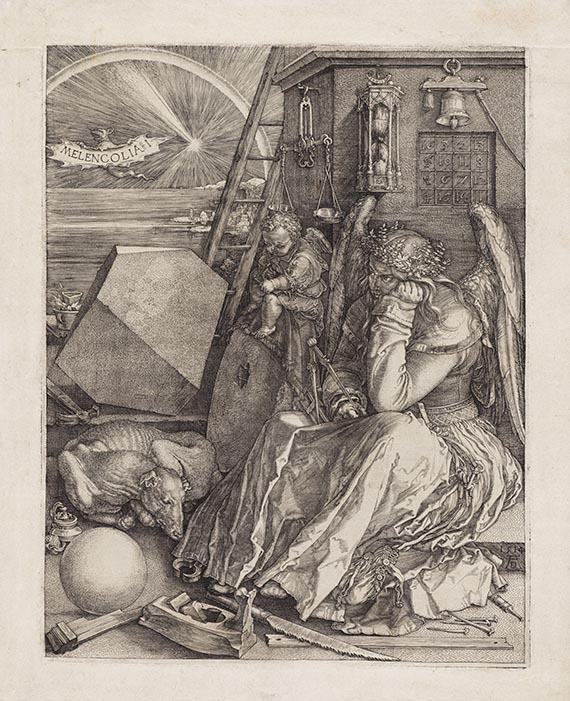
From Dürer to Doig—Melancholy and Genius: The Lonely Thinker as a Symbol of Artistic Creativity
Doig’s artistic trademarks are solitary landscapes and solitary figures, which—since the 1990s—he has often depicted wandering through his frequently snow-covered, meticulously detailed, and opaquely painted landscapes, evoking art-historical references ranging from Romanticism—most notably Caspar David Friedrich—to Edward Munch and Edward Hopper. Doig himself has also lived a kind of modern nomadic existence since early childhood: born in Scotland and raised in Trinidad and Canada, Doig experienced not only numerous changes of location but also of culture at a young age, attending a total of nine schools. He subsequently studied art in London. In 1986, he moved back to Montreal, then to London again in 1989, before finally settling with his family in Trinidad for good in 2000. Four years after this latest relocation, he created the painting “By a River” (2004) on the Caribbean island. In Trinidad, Doig doesn't just work in his studio at the Caribbean Contemporary Arts Center near the capital, Port of Spain; he also works at his home in the mountains, where he lives and works like a modern hermit—in extreme seclusion, surrounded by and inspired by the dense jungle of Caribbean vegetation. The famous series of prints “Black Palms” was created in Port of Spain in 2004; they feature the first account of the motif of the lonely, crouching, bearded man, which Doig derived from a postcard from India that the artist had purchased many years earlier at a London flea market. Doig himself described his deep fascination with this enigmatic, tiny figure on the postcard with the following words: “The figure with the beard looks like a shaman or a guru, and was about the size of a match head on a postcard among hundreds of others—although it was one of the most isolated figures, it also appeared to be the most enigmatic.” (Peter Doig, Port of Spain, March 2004). That same year, this particular figure inspired him to create the large-format painting “By a River”, in which Doig fused the mysteriously introspective figure—rendered in gently flowing colors—with the surrounding nature and the paint-soaked canvas. But what appeals to Peter Doig so much about the intensive exploration and refinement of this figure? Is it solely its loneliness and isolation, or the clarity and distinctness with which it—especially in light of European art history—stands for intellectual creativity and, by extension, everything that defines our conception of artistic genius, stretching from the Renaissance to the present day? Beginning with Albrecht Dürer’s famous copperplate engraving “Melencolia I” (1514), artistic creation came to be understood not primarily as the result of a technical creative process, but as the essence of an intense intellectual act; consequently, the artist’s intellectual capacity was increasingly equated with the contemplative temperament of the melancholic.
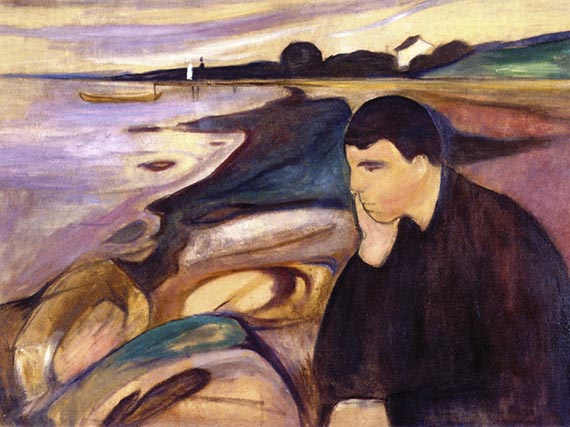
“The melancholic, viewed with great skepticism in the Middle Ages, rose to the ranks of a genius, which many—including Dürer—strove for. Melancholy and genius became interdependent. Researchers such as Schuster are right to speak of a ‘hidden self-portrait’ [..]” (R. Schoch/M. Mende/A. Scherbaum, Albrecht Dürer. Das druckgraphische Werk, vol. 1, Munich 2001, p. 183). Does this mean that Doig’s enigmatic composition “By a River,” like Dürer’s “Melancholia I,” is also a hidden self-portrait or an allegorical representation of artistic genius? This is highly likely given the rich visual tradition of the melancholic, introspective thinker, which has its deep roots in the medieval depiction of the hermit and ultimately extends from Dürer’s famous “Melencolia I,” through Salvatore Rosa, Auguste Rodin, and Edward Munch, all the way into the 21st century.
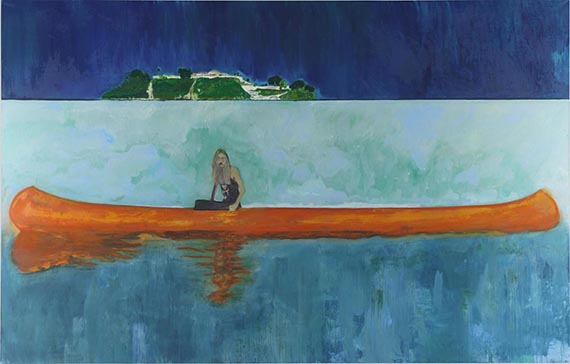
Peter Doig and Duane Allman: Pictorial Samples from “100 Years Ago” to “By a River”
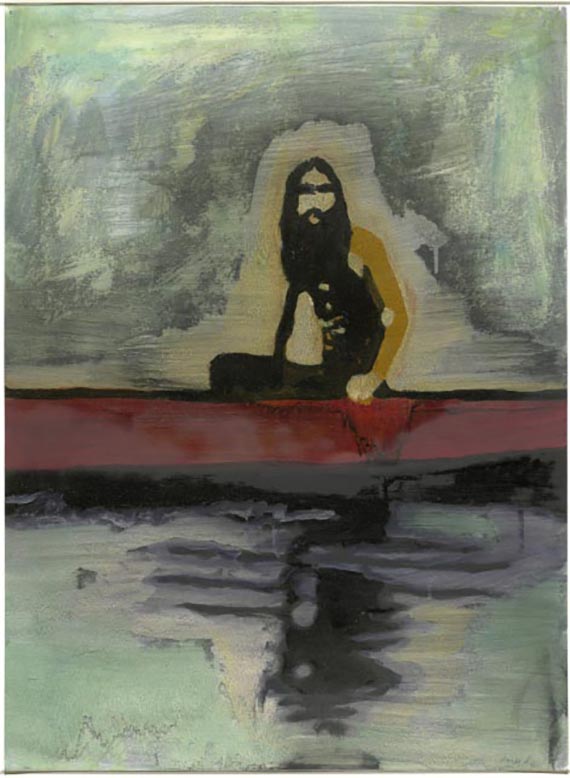
Beyond these aesthetic connections, music also inspires Peter Doig. Doig’s iconic painting “100 Years Ago (Carrera)” (2001, Centre Pompidou, Paris)—which he created three years earlier in Trinidad—also draws on the process of isolating motifs, much like “By a River”. In this case, however, Doig drew inspiration not from a postcard but from an album cover. Doig takes only the central figure— guitarist Duane Allman, who died in a car accident in 1971—from the famous photograph on the inside cover of the posthumously released double album “Duane Allman: An Anthology” (1972), incorporating just one of the six figures depicted in his painting. The canoe, floating aimlessly across the vast expanse of the lake, remains empty; the background no longer shows a rescue shore, but an island that evokes Arnold Böcklin’s painting “Toteninsel” (The Isle of the Dead). With “100 Years Ago (Carrera)”, Doig also succeeded in creating a high-quality composition through the visual superimposition of associations; like the present painting, it is imbued with a sense of oppressive loneliness and modern melancholy.
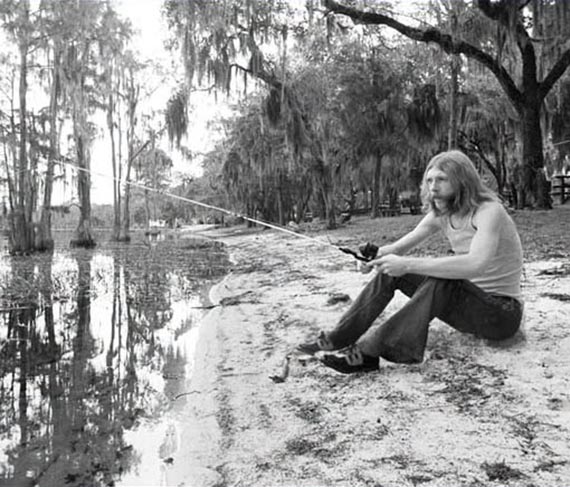
The cover of the album “Duane Allman: An Anthology” shows the legendary guitarist standing contemplatively on a riverbank with a fishing rod, and another famous photograph—also taken as part of this photo series and published in the album’s booklet—shows Allman sitting pensively on a riverbank. Peter Doig—a music enthusiast and avid record collector—had already committed these photos to his formidable visual memory when he created “By a River.” They, too, must have contributed to Doig’s deep fascination with the motif of a lonely man contemplating by the river. While painting “By a River, Doig probably listened to music, as he did so often; whether it was perhaps even Duane Allman’s legendary album remains unknown.
Doig’s magnificent creations masterfully navigate the boundary between reality and dream; time seems to stand still. It is precisely this consistent negation of space, time, and action that creates the enigmatic allure of his paintings. Deeply imbued with contemplative silence, Doig’s paintings suffuse space with their very own magical resonance. [JS].
The “sound” of Peter Doig’s large painting “By a River” (2004) is deep, enigmatic, and distinct. Doig’s paintings never cease to fascinate with their unique resonance; they glow with a mysterious, profound aura. The sensory impressions, visual experiences, and memories that converge within them are highly condensed. Almost all works from Doig’s mature creative phase are characterized by themes of isolation, loneliness, or melancholy—yet not in a negative sense. Instead, they represent an intrinsic need or fundamental human requirement, without which all intellectual—and thus ultimately artistic—creativity would be impossible. Peter Doig, the internationally acclaimed star of figurative painting, is a true master at capturing highly intensified emotions on canvas. Central to this style is a rich repository of memories drawn from his observations, literature, and personal experiences. Doig, who is also regarded as the “Pictor Doctus” of Contemporary Art, seems to absorb an unlimited array of visual experiences and stores them—sometimes for years or even decades—until they finally pour out onto the canvas to become outstanding works like “By a River” (2004), in which numerous layers intertwine. When Doig paints, imagery from art history dating back to the Middle Ages—along with film scenes, photographs, album covers, postcards, memories, impressions of nature, and emotions—merge into a highly condensed, entirely novel whole, in which all elements remain present in a fascinating way. “By a River” (2004) also captivates viewers not only because of its enormous size but, above all, because of its enigmatic motifs and the rich scope for association it offers, compelling them into an intense dialogue and personal exchange with their own images of life, buried deep in their memories.
Albrecht Dürer, Melencolia I (Melancholy I), 1514, engraving, sold at Ketterer Kunst, Evening Sale, December 8, 2023, result: ¢279.000.
From Dürer to Doig—Melancholy and Genius: The Lonely Thinker as a Symbol of Artistic Creativity
Doig’s artistic trademarks are solitary landscapes and solitary figures, which—since the 1990s—he has often depicted wandering through his frequently snow-covered, meticulously detailed, and opaquely painted landscapes, evoking art-historical references ranging from Romanticism—most notably Caspar David Friedrich—to Edward Munch and Edward Hopper. Doig himself has also lived a kind of modern nomadic existence since early childhood: born in Scotland and raised in Trinidad and Canada, Doig experienced not only numerous changes of location but also of culture at a young age, attending a total of nine schools. He subsequently studied art in London. In 1986, he moved back to Montreal, then to London again in 1989, before finally settling with his family in Trinidad for good in 2000. Four years after this latest relocation, he created the painting “By a River” (2004) on the Caribbean island. In Trinidad, Doig doesn't just work in his studio at the Caribbean Contemporary Arts Center near the capital, Port of Spain; he also works at his home in the mountains, where he lives and works like a modern hermit—in extreme seclusion, surrounded by and inspired by the dense jungle of Caribbean vegetation. The famous series of prints “Black Palms” was created in Port of Spain in 2004; they feature the first account of the motif of the lonely, crouching, bearded man, which Doig derived from a postcard from India that the artist had purchased many years earlier at a London flea market. Doig himself described his deep fascination with this enigmatic, tiny figure on the postcard with the following words: “The figure with the beard looks like a shaman or a guru, and was about the size of a match head on a postcard among hundreds of others—although it was one of the most isolated figures, it also appeared to be the most enigmatic.” (Peter Doig, Port of Spain, March 2004). That same year, this particular figure inspired him to create the large-format painting “By a River”, in which Doig fused the mysteriously introspective figure—rendered in gently flowing colors—with the surrounding nature and the paint-soaked canvas. But what appeals to Peter Doig so much about the intensive exploration and refinement of this figure? Is it solely its loneliness and isolation, or the clarity and distinctness with which it—especially in light of European art history—stands for intellectual creativity and, by extension, everything that defines our conception of artistic genius, stretching from the Renaissance to the present day? Beginning with Albrecht Dürer’s famous copperplate engraving “Melencolia I” (1514), artistic creation came to be understood not primarily as the result of a technical creative process, but as the essence of an intense intellectual act; consequently, the artist’s intellectual capacity was increasingly equated with the contemplative temperament of the melancholic.
Edvard Munch, Melankoli (Melancholy), 1894, oil on canvas, private collection.
“The melancholic, viewed with great skepticism in the Middle Ages, rose to the ranks of a genius, which many—including Dürer—strove for. Melancholy and genius became interdependent. Researchers such as Schuster are right to speak of a ‘hidden self-portrait’ [..]” (R. Schoch/M. Mende/A. Scherbaum, Albrecht Dürer. Das druckgraphische Werk, vol. 1, Munich 2001, p. 183). Does this mean that Doig’s enigmatic composition “By a River,” like Dürer’s “Melancholia I,” is also a hidden self-portrait or an allegorical representation of artistic genius? This is highly likely given the rich visual tradition of the melancholic, introspective thinker, which has its deep roots in the medieval depiction of the hermit and ultimately extends from Dürer’s famous “Melencolia I,” through Salvatore Rosa, Auguste Rodin, and Edward Munch, all the way into the 21st century.
Peter Doig, 100 Years Ago (Carrera), 2001, oil on canvas, Centre Pompidou, Paris. © Peter Doig. All rights reserved / VG Bild-Kunst, Bonn 2026
Peter Doig and Duane Allman: Pictorial Samples from “100 Years Ago” to “By a River”
Beyond these aesthetic connections, music also inspires Peter Doig. Doig’s iconic painting “100 Years Ago (Carrera)” (2001, Centre Pompidou, Paris)—which he created three years earlier in Trinidad—also draws on the process of isolating motifs, much like “By a River”. In this case, however, Doig drew inspiration not from a postcard but from an album cover. Doig takes only the central figure— guitarist Duane Allman, who died in a car accident in 1971—from the famous photograph on the inside cover of the posthumously released double album “Duane Allman: An Anthology” (1972), incorporating just one of the six figures depicted in his painting. The canoe, floating aimlessly across the vast expanse of the lake, remains empty; the background no longer shows a rescue shore, but an island that evokes Arnold Böcklin’s painting “Toteninsel” (The Isle of the Dead). With “100 Years Ago (Carrera)”, Doig also succeeded in creating a high-quality composition through the visual superimposition of associations; like the present painting, it is imbued with a sense of oppressive loneliness and modern melancholy.
Peter Doig, 100 Years Ago, 2002, oil on paper, Museum of Modern Art, New York. © Peter Doig. All rights reserved / VG Bild-Kunst, Bonn 2026
The cover of the album “Duane Allman: An Anthology” shows the legendary guitarist standing contemplatively on a riverbank with a fishing rod, and another famous photograph—also taken as part of this photo series and published in the album’s booklet—shows Allman sitting pensively on a riverbank. Peter Doig—a music enthusiast and avid record collector—had already committed these photos to his formidable visual memory when he created “By a River.” They, too, must have contributed to Doig’s deep fascination with the motif of a lonely man contemplating by the river. While painting “By a River, Doig probably listened to music, as he did so often; whether it was perhaps even Duane Allman’s legendary album remains unknown.
Doig’s magnificent creations masterfully navigate the boundary between reality and dream; time seems to stand still. It is precisely this consistent negation of space, time, and action that creates the enigmatic allure of his paintings. Deeply imbued with contemplative silence, Doig’s paintings suffuse space with their very own magical resonance. [JS].
Duane Allman, Fishing in Florida, a reproduction of the photograph was published in the booklet of the album “Duane Allman. An Anthology” (1972), ca. 1970, photo: Stephen Paley.
Commissione, tassa e diritti di seguito
Quest'oggetto viene offerto con regime fiscale normale o con imposizione sul margine di profitto.
Calcolo commissione particolare sul margine del profitto:
- Prezzo d’aggiudicazione fino a 2.000.000 euro: provvigione del 34%.
- Per la parte del prezzo d’aggiudicazione superiore a 2.000.000 euro si calcola una provvigione del 29%, che viene aggiunta a quella relativa alla parte del prezzo d’aggiudicazione fino a 2.000.000 euro.
- Per la parte del prezzo d’aggiudicazione superiore a 4.000.000 euro si calcola una provvigione del 22%, che viene aggiunta a quella relativa alla parte del prezzo d’aggiudicazione fino a 4.000.000 euro.
La provvigione comprende l'IVA, ma questa non viene indicata.
Calcolo regime fiscale normale:
Prezzo di aggiudicazione fino a 2.000.000 €: supplemento del 29%.
Prezzo di aggiudicazione superiore a 2.000.000 €: Parte del prezzo fino a 2.000.000 € supplemento del 29 %, parte del prezzo che supera i 2.000.000 € supplemento del 23%.
Prezzo di aggiudicazione superiore a 4.000.000 €: Parte del prezzo che supera i 4.000.000 € supplemento del 15%.
L'IVA prevista dalla legge è pari al 7 % sulla somma del prezzo di aggiudicazione e del supplemento.
La preghiamo di avvisarci prima della fatturazione nel caso in cui desidera applicare il regime fiscale normale.
Calcolo diritti di seguito:
Per le opere originali di arti figurative e fotografie di artisti viventi o deceduti da meno di 70 anni soggette al diritto di seguito, in tutti i casi suddetti viene riscossa in aggiunta, a liquidazione della compensazione del diritto di seguito dovuto dalla casa d'aste ai sensi del § 26 della legge tedesca sul diritto d'autore (Urheberrechtsgesetz, UrhG), una compensazione del diritto di seguito con le percentuali indicate nel § 26 2° comma UrhG, che attualmente sono le seguenti:
4 per cento della parte del ricavo della vendita da 400,00 euro a 50.000 euro,
un altro 3 per cento della parte del ricavo della vendita da 50.000,01 a 200.000 Euro,
un altro 1 per cento della parte del ricavo della vendita da 200.000,01 a 350.000 Euro,
un altro 0,5 per cento della parte del ricavo della vendita da 350.000,01 a 500.000 euro e
un altro 0,25 per cento della parte del ricavo della vendita superiore a 500.000 euro.
L’importo complessivo della compensazione del diritto di seguito derivante da una rivendita è pari al massimo a 12.500 euro.