


Cornice
Altre immagini
Altre immagini
Raumbeispiel
8
Karl Schmidt-Rottluff
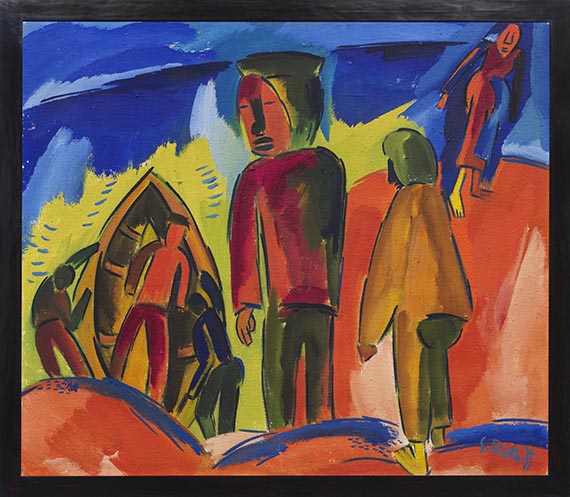
Fischer auf der Düne, 1921.
Olio su tela
Stima: € 400,000 / $ 448,000
8
Karl Schmidt-Rottluff
Fischer auf der Düne, 1921.
Olio su tela
Stima: € 400,000 / $ 448,000
Karl Schmidt-Rottluff
1884 - 1976
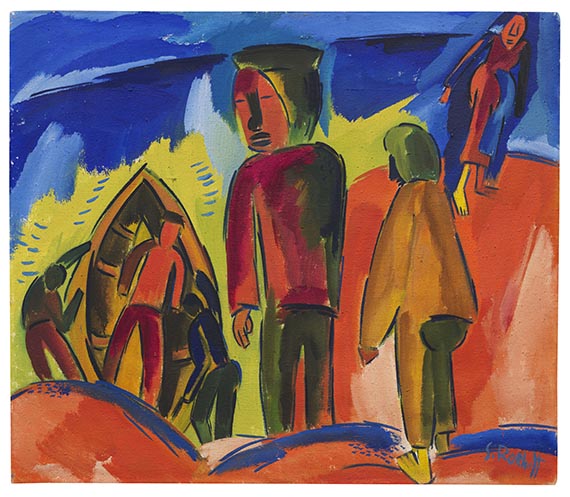
Fischer auf der Düne. 1921.
Oil on canvas.
Signed in the lower right. Signed, titled, and inscribed with the work number “213” on the reverse of the stretcher. Once more inscribed with the work number on the reverse of the partially overpainted canvas. 87.5 x 100.5 cm (34.4 x 39.5 in). [CH].
• EXPRESSIVE Rich colors, expansive surfaces, and reduced forms.
• INSPIRATION Schmidt-Rottluff spent the summer months in Jershöft on the Baltic Sea between 1920 and 1931.
• TURNING POINT Through his exploration of man and nature, the artist attained a whole new confidence in color.
• PROVENANCE Once part of the outstanding collection of Berthold and Else Beitz, Essen, for over 65 years.
• MUSEUM QUALITY Similar paintings are at, among others, the Brücke Museum in Berlin, the Grand Rapids Art Museum in Michigan, the Kunsthalle Hamburg, and the Museum Folkwang in Essen.
The work is documented in the archives of the Karl and Emy Schmidt-Rottluff Foundation, Berlin.
PROVENANCE: Ferdinand Möller Collection, Berlin (presumably acquired directly from the artist in 1922).
Detroit Institute of Arts, Detroit, Michigan (taken into storage in March 1938 as a loan from the above; confiscated as “enemy property” by the U.S. government in December 1940).
U.S. government property (1950–1957; ownership of the above-mentioned property was transferred through “Vesting Order 15411” by the Office of Alien Property at the Department of Justice on October 30, 1950).
Maria Möller-Garny, Cologne (repurchased from the U.S. government in 1957).
Angelika Fessler-Möller, Cologne (from the above)
Berthold and Else Beitz Collection, Essen (acquired from the above in 1959 through the mediation of Galerie Grosshennig, Düsseldorf; in the family’s possession until 2024).
Dietmar Manke Collection, Schleswig-Holstein (acquired from the above in 2024, Ketterer Kunst).
EXHIBITION: Neue Kunst Hans Goltz, Munich (with a fragmentarily preserved label on the reverse of the stretcher).
Schmidt-Rottluff traveling exhibition, Galerie Möller, Berlin; Danzig Museum, Nov. 1928–March 1929 (neither exhibition was accompanied by a catalog).
Karl Schmidt-Rottluff, Gemälde, Aquarelle, Graphik, Bernsteinschmuck, Kunstsammlungen der Stadt Königsberg / Kunstverein Königsberg, Dec. 30, 1928–Jan. 20, 1929, Cat. No. 18.
Kunstwerke aus drei Jahrtausenden gesammelt im Ruhrgebiet, Kunsthalle Recklinghausen, May 16–July 16, 1963, cat. no. 212 (illustrated)
Pomeranian State Museum, Greifswald (permanent loan 2015–2024)
Zwei Männer – ein Meer. Pechstein und Schmidt-Rottluff an der Ostsee, Pomeranian State Museum, Greifswald, March 29–June 28, 2015, cat. no. 9 (dated 1920 here, illustrated on p. 81).
LITERATURE: Will Grohmann, Karl Schmidt-Rottluff, Stuttgart 1956, p. 266 (illustrated in black-and-white) and on p. 292.
- -
Galerie Wilhelm Grosshennig (ed.), 10 Jahre Kunsthandel in Düsseldorf 1951–1961, Düsseldorf 1961 (illustrated and with a different date, “1920”).
Eberhard Roters, Galerie Ferdinand Möller: die Geschichte einer Galerie für Moderne Kunst in Deutschland 1917–1956, Berlin 1984, pp. 156 and 226.
Katrin Engelhardt, Ferdinand Möller und seine Galerie. Ein Kunsthändler in Zeiten historischer Umbrüche, Ph.D. thesis, Hamburg 2013, https://ediss.sub.uni-hamburg.de/bitstream/ediss/5203/1/Dissertation.pdf, p. 122, note 337 (accessed Oct. 13, 2026).
Ketterer Kunst, Munich, Auction 560, Evening Sale, Dec. 6, 2024, lot 19 (illustrated).
ARCHIVE MATERIALS (selection):
Index card from the art inventory of the Ferdinand Möller Gallery (“Fisherman on the Dune, oil on canvas” by Karl Schmidt-Rottluff), in: Index Card Boxes, Berlinische Galerie, Berlin, Ferdinand Möller Estate, BG-KA-N/F.Möller-KK.
Business correspondence between the Ferdinand Möller Gallery and the Art Collections of the Free City of Danzig, Berlinische Galerie, Berlin, Ferdinand Möller Estate, BG-GFM-C, II 1, 587f.
Business correspondence between the Ferdinand Möller Gallery and Dr. Wilhelm Reinhold Valentiner, Director of the Detroit Institute of Arts, Detroit (USA), Berlinische Galerie Berlin, Ferdinand Möller Estate, BG-GFM-C, II 1, 115 (among others).
Customs invoice and customs declaration for the import of 18 oil paintings from the Ferdinand Möller Gallery to the Detroit Institute of Arts, 1938, Berlinische Galerie Berlin, Ferdinand Möller Estate, BG-KA-N/F.Möller-66-M66,18-23.
Department of Justice, Office of Alien Property, Washington, D.C., and others: Purchase agreement between the Office of Alien Property of the U.S. Department of Justice and Maria Möller-Garny regarding the repurchase of 19 paintings in storage at the Detroit Institute of Arts, Berlinische Galerie, Berlin, Ferdinand Möller Estate, BG-KA-N/F.Möller-68-M68,88-89.
"After World War I, in the early 1920s […], Schmidt-Rottluff took it a step further and allowed the figures […], through rhythmic forms and areas of color extending beyond the contours, to merge inseparably with the landscape on a single plane. In this way, he creates an extremely dense tapestry of color, enlivened by the dynamism of the [.] figures, jagged outlines, and the complementary contrasts that flare up here and there, skillfully interwoven within the composition."
Roman Zieglgänsberger, Curator of Modern Art, Museum Wiesbaden, quoted from: Exhibition catalog Karl Schmidt-Rottluff. Landschaft, Figur, Stillleben, Brücke Museum Berlin, 2014/2015, p. 96
“The air's incredible blue is truly refreshing, and the clear colors, set off so distinctly against one another—perhaps the colors aren't quite as deep here [..]—but they are just as steely and unambiguous.”
Karl Schmidt-Rottluff in a letter to Ernst Beyersdorff dated June 22, 1922.
Called up: December 4, 2026 - ca. 17.14 h +/- 20 min.
Notable Works from the Interwar Years in Museums and Institutions
After World War I, Karl Schmidt-Rottluff entered a particularly productive creative period. Through the mid-1920s, he produced impressive paintings, many of which, however, were lost during World War II due to relocation, political turmoil, and destruction. The surviving paintings rank among the highlights of the artist’s oeuvre, many of which are located in renowned German and international museums, including the Kunstmuseum Bern, the Buchheim Museum in Bernried, the Brücke Museum, the Nationalgalerie, and the Georg Kolbe Museum in Berlin, the Chemnitz Art Collections, the Museum Folkwang in Essen, the Kunstmuseum Gelsenkirchen, the Grand Rapids Art Museum (Michigan), the Kunsthalle Hamburg, the Sprengel Museum in Hanover, the Tate Gallery in London, the Pinakothek der Moderne in Munich, the Ernst von Siemens Art Foundation, Munich/Berlin, the LWL Museum of Art and Culture in Münster, and the Museum Wiesbaden.
In particular, the series of paintings depicting workers and artisans, created between the two world wars, is widely regarded as the most significant body of work from that period of his career.
Jershöft: Retreat and Source of Inspiration
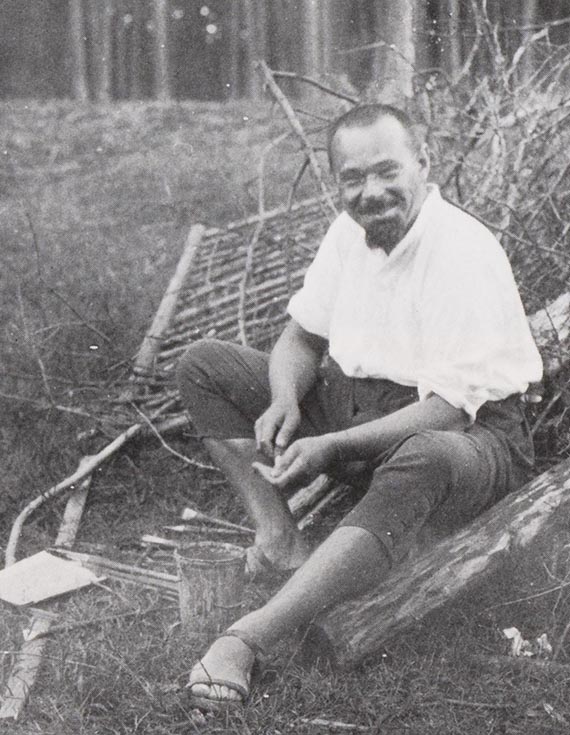
Starting in 1920, Karl Schmidt-Rottluff and his wife, Emy, traveled to Jershöft in East Pomerania for the first time; they returned every summer for the next 11 years, until 1931. Escaping the city's hustle and bustle, they enjoyed the silence and solitude, the simple life, and the vast, unspoiled nature of this village of about 300 inhabitants. Amid the upheavals of the time, the couple found time to “finally regain their composure” (Schmidt-Rottluff in a letter to the collector Ernst Beyersdorff, June 21, 1920, quoted from: Exhibition catalog Karl Schmidt-Rottluff. Expressiv – magisch – fremd, Munich 2018, p. 27).
In addition to its peaceful tranquillity, the Pomeranian landscape soon became an indispensable source of inspiration for Schmidt-Rottluff: “This indescribable blue of the air is in itself a great refreshment, as are the clear, contrasting colors” (the artist in a letter to Ernst Beyersdorff, June 22, 1922, quoted from: ibid.).
Schmidt-Rottluff was working, among other things, on several expressive depictions of working people from various walks of life in Jershöft at that time—works for which no parallels can be found in contemporary German painting.
“The preferred motifs that defined Schmidt-Rottluff’s oeuvre until around 1924 can be traced back to his stays in Jershöft. Paintings depicting workers, farmers, or fishermen follow the prevailing trend to fuse the human, the social, and the spiritual. [...] Thus, the human being par excellence is captured going about his daily work, in the exercise of his profession.” (Magdalena M. Moeller, in: Magdalena M. Moeller, Karl Schmidt-Rottluff. Eine Monographie, Munich 2010, pp. 67ff.)
Schmidt-Rottluff explored the everyday physical labor of the fishermen living in Jershöft through watercolors, drawings, postcards, and paintings: fishing and angling in any weather, launching and landing boats, mending nets and smoking fish, rowing, towing, and rafting; he also created numerous depictions of the lives of farmers and artisans. The present painting, “Fischer auf der Düne,” is one of the stylistically representative masterpieces from the series Schmidt-Rottluff produced until the mid-1920s.
Rich colors, ample surface areas, and reduced forms: “Fishermen on the Dune”
His 1921 summer stay began in early June and ended on September 14, when he returned to Berlin. “Fishermen on the Dune” was created in light of those summer experiences. The artist merely observed the dynamic, multi-figure scene as a silent witness; most of the figures have their backs turned to him as they go about their work. Although the subject matter depicts the fishermen’s hard labor, Schmidt-Rottluff is fundamentally concerned with the composition—with forms emerging from bold colors—and with expressive painting.
The artist skillfully divides the pictorial space into three zones, each distinguished from the others by color: dunes, sand, and resting figures on the right; an active, dynamic zone depicting the fishermen at work, which he marks with a bold greenish-yellow and which extends diagonally from the lower left half of the painting to the upper right; and finally, the sea in a radiant blue. A few contours are rendered in black; the fishermen and the boat assume sculptural forms. The figures in the upper right and the lower left of the painting create an illusion of spatial depth.
Pure, rich colors of deep luminosity are juxtaposed. They interlock and lend rhythm to the painting's elements. The intense orange, the deep blue of the sea, and the luminous greenish-yellow of the water churned up by the boat create a powerful chromatic harmony. At times, the forms even seem to dissolve into the expanse of color, resulting in an almost chromatic abstraction.
“The monumentality that Kirchner believed he had already recognized in Schmidt-Rottluff’s early paintings created on Alsen in 1906, [...] is once again clearly evident in all of these works. Generous, reduced forms and large areas of color define the composition. [...] Within the boundaries defined by these areas, color takes on a life of its own. Time and again, the same hues are favored and blended into a harmonious whole: vivid blue, olive-colored ochre, and reddish-brown dominate. The figures and objects sometimes take on arbitrary forms that are heightened in their expressiveness [...]. [Schmidt-Rottluff] develops a colorful, surface-based style in his paintings of workers, artisans, and fishermen, which gives his art new impetus. [...] Schmidt-Rottluff achieves a high degree of formal and chromatic abstraction, yet he never loses touch with visible reality” (Magdalena M. Moeller, in: Magdalena M. Moeller, Karl Schmidt-Rottluff. A Monograph, Munich 2010, p. 67ff.) [CH]
An Eventful Provenance
Art dealer Ferdinand Möller acquired the painting shortly after it was created. Möller, originally a bookseller, started his extremely successful career in 1912 at the famous Galerie Arnold in Dresden; its owner at the time, Ludwig Gutbier, organized the seminal exhibition of the “Brücke” artists in 1910. In 1913, Möller opened a branch of Galerie Arnold in Breslau, before setting up his own independent gallery on Potsdamer Straße in Berlin in October 1918. Among others, Möller represented the artists of the recently disbanded “Brücke” group: Erich Heckel, Ernst Ludwig Kirchner, Otto Mueller, Emil Nolde, and Karl Schmidt-Rottluff. The present painting “Fisherman on the Dune” was also part of the gallery’s inventory at that time. In July 1937, the controversial Nazi propaganda exhibition “Degenerate Art” opened in Munich; the artworks confiscated from museums were ultimately expropriated by law by Hitler on May 1, 1938. In response, Möller lent 19 works, including “Fisherman on the Dune”, to a friend, the art historian Wilhelm R. Valentiner, in Detroit. Valentiner had been director of the Detroit Institute of Arts since 1924 and had published the first monograph on the work of Karl Schmidt-Rottluff in 1920. Pursuant to the “Vesting Order” issued by the Department of Justice’s Office of Alien Property on October 30, 1950, Möller’s collection was seized as “enemy property” and taken over by the U.S. government. After long and arduous negotiations—Ferdinand Möller died in January 1956—17 of the paintings that had originally been sent on loan finally returned to Germany in January 1958. The family donated the two remaining paintings—Wassily Kandinsky’s “Picture with a White Form” (1913) and Lyonel Feininger’s “Green Bridge” (1916)—to the Detroit Institute of Arts and the North Carolina Museum of Arts in Raleigh as compensation.
Finally, the Chemnitz-born art dealer Wilhelm Grosshennig arranged for the painting “Fisherman on the Dune” to be acquired by the important Berthold and Else Beitz Collection in Essen. From there, the work eventually came into the possession of the Schleswig-Holstein collector Dietmar Manke.
After World War I, Karl Schmidt-Rottluff entered a particularly productive creative period. Through the mid-1920s, he produced impressive paintings, many of which, however, were lost during World War II due to relocation, political turmoil, and destruction. The surviving paintings rank among the highlights of the artist’s oeuvre, many of which are located in renowned German and international museums, including the Kunstmuseum Bern, the Buchheim Museum in Bernried, the Brücke Museum, the Nationalgalerie, and the Georg Kolbe Museum in Berlin, the Chemnitz Art Collections, the Museum Folkwang in Essen, the Kunstmuseum Gelsenkirchen, the Grand Rapids Art Museum (Michigan), the Kunsthalle Hamburg, the Sprengel Museum in Hanover, the Tate Gallery in London, the Pinakothek der Moderne in Munich, the Ernst von Siemens Art Foundation, Munich/Berlin, the LWL Museum of Art and Culture in Münster, and the Museum Wiesbaden.
In particular, the series of paintings depicting workers and artisans, created between the two world wars, is widely regarded as the most significant body of work from that period of his career.
Jershöft: Retreat and Source of Inspiration
Starting in 1920, Karl Schmidt-Rottluff and his wife, Emy, traveled to Jershöft in East Pomerania for the first time; they returned every summer for the next 11 years, until 1931. Escaping the city's hustle and bustle, they enjoyed the silence and solitude, the simple life, and the vast, unspoiled nature of this village of about 300 inhabitants. Amid the upheavals of the time, the couple found time to “finally regain their composure” (Schmidt-Rottluff in a letter to the collector Ernst Beyersdorff, June 21, 1920, quoted from: Exhibition catalog Karl Schmidt-Rottluff. Expressiv – magisch – fremd, Munich 2018, p. 27).
In addition to its peaceful tranquillity, the Pomeranian landscape soon became an indispensable source of inspiration for Schmidt-Rottluff: “This indescribable blue of the air is in itself a great refreshment, as are the clear, contrasting colors” (the artist in a letter to Ernst Beyersdorff, June 22, 1922, quoted from: ibid.).
Schmidt-Rottluff was working, among other things, on several expressive depictions of working people from various walks of life in Jershöft at that time—works for which no parallels can be found in contemporary German painting.
“The preferred motifs that defined Schmidt-Rottluff’s oeuvre until around 1924 can be traced back to his stays in Jershöft. Paintings depicting workers, farmers, or fishermen follow the prevailing trend to fuse the human, the social, and the spiritual. [...] Thus, the human being par excellence is captured going about his daily work, in the exercise of his profession.” (Magdalena M. Moeller, in: Magdalena M. Moeller, Karl Schmidt-Rottluff. Eine Monographie, Munich 2010, pp. 67ff.)
Schmidt-Rottluff explored the everyday physical labor of the fishermen living in Jershöft through watercolors, drawings, postcards, and paintings: fishing and angling in any weather, launching and landing boats, mending nets and smoking fish, rowing, towing, and rafting; he also created numerous depictions of the lives of farmers and artisans. The present painting, “Fischer auf der Düne,” is one of the stylistically representative masterpieces from the series Schmidt-Rottluff produced until the mid-1920s.
Karl Schmidt-Rottluff in Jershöft, 1921, photo: unknown.
Rich colors, ample surface areas, and reduced forms: “Fishermen on the Dune”
His 1921 summer stay began in early June and ended on September 14, when he returned to Berlin. “Fishermen on the Dune” was created in light of those summer experiences. The artist merely observed the dynamic, multi-figure scene as a silent witness; most of the figures have their backs turned to him as they go about their work. Although the subject matter depicts the fishermen’s hard labor, Schmidt-Rottluff is fundamentally concerned with the composition—with forms emerging from bold colors—and with expressive painting.
The artist skillfully divides the pictorial space into three zones, each distinguished from the others by color: dunes, sand, and resting figures on the right; an active, dynamic zone depicting the fishermen at work, which he marks with a bold greenish-yellow and which extends diagonally from the lower left half of the painting to the upper right; and finally, the sea in a radiant blue. A few contours are rendered in black; the fishermen and the boat assume sculptural forms. The figures in the upper right and the lower left of the painting create an illusion of spatial depth.
Pure, rich colors of deep luminosity are juxtaposed. They interlock and lend rhythm to the painting's elements. The intense orange, the deep blue of the sea, and the luminous greenish-yellow of the water churned up by the boat create a powerful chromatic harmony. At times, the forms even seem to dissolve into the expanse of color, resulting in an almost chromatic abstraction.
“The monumentality that Kirchner believed he had already recognized in Schmidt-Rottluff’s early paintings created on Alsen in 1906, [...] is once again clearly evident in all of these works. Generous, reduced forms and large areas of color define the composition. [...] Within the boundaries defined by these areas, color takes on a life of its own. Time and again, the same hues are favored and blended into a harmonious whole: vivid blue, olive-colored ochre, and reddish-brown dominate. The figures and objects sometimes take on arbitrary forms that are heightened in their expressiveness [...]. [Schmidt-Rottluff] develops a colorful, surface-based style in his paintings of workers, artisans, and fishermen, which gives his art new impetus. [...] Schmidt-Rottluff achieves a high degree of formal and chromatic abstraction, yet he never loses touch with visible reality” (Magdalena M. Moeller, in: Magdalena M. Moeller, Karl Schmidt-Rottluff. A Monograph, Munich 2010, p. 67ff.) [CH]
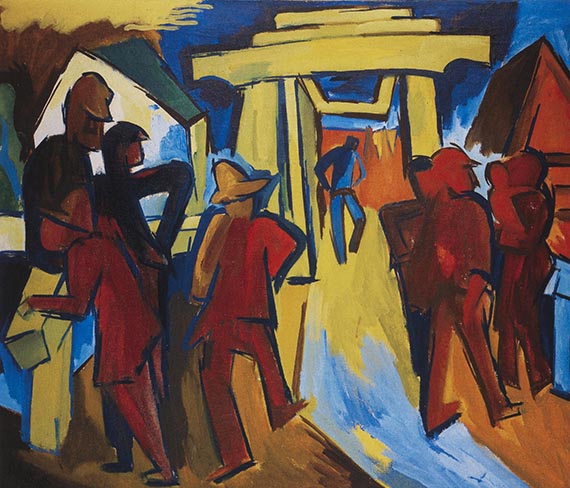
Karl Schmidt-Rottluff, Fischersonntag (Fishermen’s Sunday), 1923, oil on canvas, Brücke-Museum, Berlin. © VG Bild-Kunst, Bonn 2026
An Eventful Provenance
Art dealer Ferdinand Möller acquired the painting shortly after it was created. Möller, originally a bookseller, started his extremely successful career in 1912 at the famous Galerie Arnold in Dresden; its owner at the time, Ludwig Gutbier, organized the seminal exhibition of the “Brücke” artists in 1910. In 1913, Möller opened a branch of Galerie Arnold in Breslau, before setting up his own independent gallery on Potsdamer Straße in Berlin in October 1918. Among others, Möller represented the artists of the recently disbanded “Brücke” group: Erich Heckel, Ernst Ludwig Kirchner, Otto Mueller, Emil Nolde, and Karl Schmidt-Rottluff. The present painting “Fisherman on the Dune” was also part of the gallery’s inventory at that time. In July 1937, the controversial Nazi propaganda exhibition “Degenerate Art” opened in Munich; the artworks confiscated from museums were ultimately expropriated by law by Hitler on May 1, 1938. In response, Möller lent 19 works, including “Fisherman on the Dune”, to a friend, the art historian Wilhelm R. Valentiner, in Detroit. Valentiner had been director of the Detroit Institute of Arts since 1924 and had published the first monograph on the work of Karl Schmidt-Rottluff in 1920. Pursuant to the “Vesting Order” issued by the Department of Justice’s Office of Alien Property on October 30, 1950, Möller’s collection was seized as “enemy property” and taken over by the U.S. government. After long and arduous negotiations—Ferdinand Möller died in January 1956—17 of the paintings that had originally been sent on loan finally returned to Germany in January 1958. The family donated the two remaining paintings—Wassily Kandinsky’s “Picture with a White Form” (1913) and Lyonel Feininger’s “Green Bridge” (1916)—to the Detroit Institute of Arts and the North Carolina Museum of Arts in Raleigh as compensation.
Finally, the Chemnitz-born art dealer Wilhelm Grosshennig arranged for the painting “Fisherman on the Dune” to be acquired by the important Berthold and Else Beitz Collection in Essen. From there, the work eventually came into the possession of the Schleswig-Holstein collector Dietmar Manke.
Commissione, tassa e diritti di seguito
Quest'oggetto viene offerto con regime fiscale normale o con imposizione sul margine di profitto.
Calcolo commissione particolare sul margine del profitto:
- Prezzo d’aggiudicazione fino a 2.000.000 euro: provvigione del 34%.
- Per la parte del prezzo d’aggiudicazione superiore a 2.000.000 euro si calcola una provvigione del 29%, che viene aggiunta a quella relativa alla parte del prezzo d’aggiudicazione fino a 2.000.000 euro.
- Per la parte del prezzo d’aggiudicazione superiore a 4.000.000 euro si calcola una provvigione del 22%, che viene aggiunta a quella relativa alla parte del prezzo d’aggiudicazione fino a 4.000.000 euro.
La provvigione comprende l'IVA, ma questa non viene indicata.
Calcolo regime fiscale normale:
Prezzo di aggiudicazione fino a 2.000.000 €: supplemento del 29%.
Prezzo di aggiudicazione superiore a 2.000.000 €: Parte del prezzo fino a 2.000.000 € supplemento del 29 %, parte del prezzo che supera i 2.000.000 € supplemento del 23%.
Prezzo di aggiudicazione superiore a 4.000.000 €: Parte del prezzo che supera i 4.000.000 € supplemento del 15%.
L'IVA prevista dalla legge è pari al 7 % sulla somma del prezzo di aggiudicazione e del supplemento.
La preghiamo di avvisarci prima della fatturazione nel caso in cui desidera applicare il regime fiscale normale.
Calcolo diritti di seguito:
Per le opere originali di arti figurative e fotografie di artisti viventi o deceduti da meno di 70 anni soggette al diritto di seguito, in tutti i casi suddetti viene riscossa in aggiunta, a liquidazione della compensazione del diritto di seguito dovuto dalla casa d'aste ai sensi del § 26 della legge tedesca sul diritto d'autore (Urheberrechtsgesetz, UrhG), una compensazione del diritto di seguito con le percentuali indicate nel § 26 2° comma UrhG, che attualmente sono le seguenti:
4 per cento della parte del ricavo della vendita da 400,00 euro a 50.000 euro,
un altro 3 per cento della parte del ricavo della vendita da 50.000,01 a 200.000 Euro,
un altro 1 per cento della parte del ricavo della vendita da 200.000,01 a 350.000 Euro,
un altro 0,5 per cento della parte del ricavo della vendita da 350.000,01 a 500.000 euro e
un altro 0,25 per cento della parte del ricavo della vendita superiore a 500.000 euro.
L’importo complessivo della compensazione del diritto di seguito derivante da una rivendita è pari al massimo a 12.500 euro.