


Cornice
Altre immagini
22
Georg Baselitz
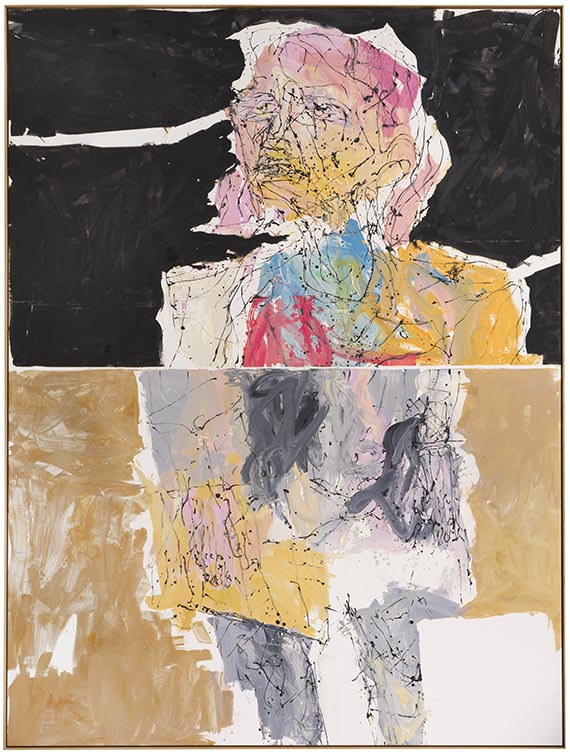
Melancholisches Design, 2011.
Oil and gold bronze on canvas
Stima: € 500,000 / $ 560,000
22
Georg Baselitz
Melancholisches Design, 2011.
Oil and gold bronze on canvas
Stima: € 500,000 / $ 560,000
Georg Baselitz
1938 - 2026
Melancholisches Design. 2011.
Oil and gold bronze on canvas.
Signed, dated “29.XXII.011,” and titled on the reverse side of the canvas. 400 x 300 cm (157.4 x 118.1 in). [CH].
• VARIETY Interplay of spontaneous drawing, dripping, and dynamic painting.
• MONUMENTAL The fascinating composition fills the entire space on the large canvas.
• REMIX Deeply rooted in European and American art history, he subjects his famous Fraktur paintings from the 1960s to a radical reevaluation.
• TRIBUTE In recent years, the artist—who passed away this year—has been honored with major retrospective exhibitions at, among others, the Munch Museum in Oslo (2025), White Cube in London (2024), the Kunsthistorisches Museum, Vienna (2023), the Centre Pompidou in Paris (2021/22), and the Fondation Beyeler in Basel (2018).
We are grateful to the Georg Baselitz Archive in Munich for their kind assistance. The work is registered in the archive.
PROVENANCE: Gagosian Gallery, New York (with the label on the stretcher).
From a major private collection, New York (acquired from the above in 2012).
EXHIBITION: Georg Baselitz. New Paintings and a Sculpture, Gagosian, New York, Feb. 28–Apr. 7, 2012, pp. 28 and 87 (with illu., p. 29, as well as pp. 2, 11, and 15).
LITERATURE: Detlev Gretenkort (ed.), Georg Baselitz. Danse gothique, Écrits et entretiens 1961–2019, Strasbourg 2020 (with illu. no. 123).
Detlev Gretenkort (ed.), Georg Baselitz. Collected Writings and Interviews, London 2022, p. 396 (with illu., p. 381).
Georg Baselitz, Cahiers d’Art, Paris 2024/25, p. 260 (with illu., p. 147).
Called up: December 4, 2026 - ca. 17.42 h +/- 20 min.
Six Decades of Artistic Evolution
With a versatile, radical artistic output spanning six decades, the late Georg Baselitz ranks among the most significant and successful German painters of his generation.
In the mid-20th century, his provocative, expressive paintings significantly contributed to the renewal of figurative post-war painting. In the years and decades that followed, Baselitz subjected his painting to constant evolution, resulting in an oeuvre of great thematic and stylistic richness, in which the human figure—in its most diverse forms and often entirely devoid of a narrative dimension—always plays a central role, both in terms of subject matter and concept.
Among his most significant early creative phases and exemplary key works are, among others, the so-called “Hero Paintings” and “Fraktur Paintings” of the 1960s, followed by the first upside-down paintings in 1969. Baselitz then worked on successive groups of works in which he experimented with great mastery using new painterly techniques and different aesthetic approaches. He drew inspiration from history, European and American art, and his extensive knowledge of countless influential artists, including Edvard Munch, Otto Dix, and Willem de Kooning. Later, he created the so-called “Russian Paintings” as well as self-reflexive series such as the “Remix” series, to which the present work belongs.
Remix: Retrospective, Self-Criticism, and Radical Innovation
Since 2005, Georg Baselitz has explored the idea of taking visual motifs from his 1960s paintings and drawings, critically reinterpreting them, and transforming them into entirely new works. With the help of photocopies, drawings, and illustrations from catalogs, the artist delves into the past to bring his own works into the present by employing different painting techniques and a mindset that has been shaped by five decades of experience. “Baselitz’s visual universe [functions] like a hall of mirrors, in which his own images merge with art-historical models to form new pictorial compositions.” (Press release for the retrospective “Georg Baselitz” at the Fondation Beyeler, Riehen)
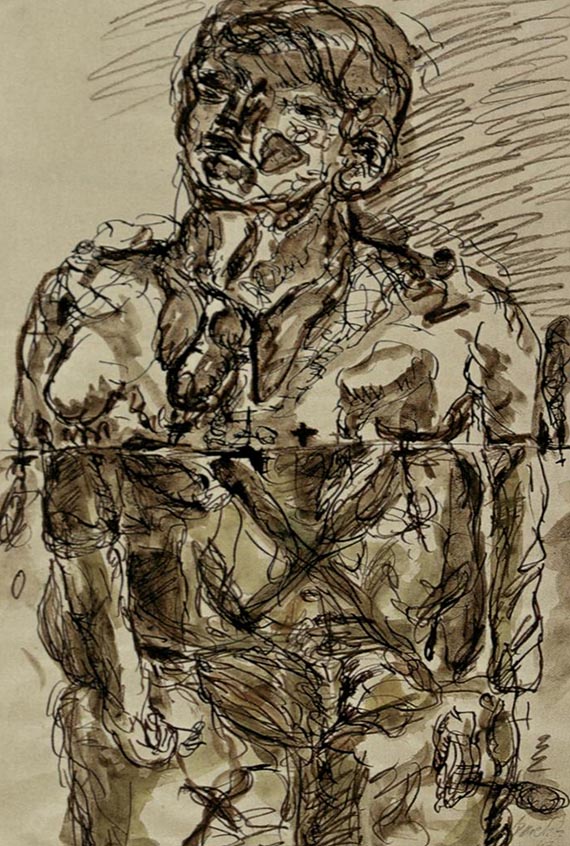
The “Fraktur” paintings from 1965–1968 are based on drawings that the artist said depict his wife, Elke Kretzschmar. At the time, he wasn’t entirely sure; today, he knows it to be fact.
“Back then, I had the feeling that these drawings had only partially become pictures. Many of them didn’t seem to work as paintings. Today, I take these old drawings out again and tell myself: This is worth it. You absolutely have to do this. It has to become a larger painting,” explains the artist (quoted from: Exhibition catalog Georg Baselitz: New Paintings and a Sculpture, Gagosian Gallery, New York 2012, p. 12).
While painting, Baselitz holds a photograph of the original work in his left hand and uses it as a guide during the creative process. In these “Remix” paintings, he contrasts the powerful brushwork and saturated paint application characteristic of the 1960s with the lucid transparency of paint drippings, which he “mixes” on a canvas divided into two halves, using bold, even metallic-glossy colors that he applies generously, along with a playful internal drawing. Baselitz explains: “On top of what once possessed its own inner coherence, I apply a different method, at times even a different style or other, very distinct colors, or sometimes I just blur it with white and add a drawing on top. I try to preserve one thing: the original impulse. A different painter created these earlier works. Certainly, it was me, but in a different frame of mind and with a different intention. It is impossible to recapture that forty-five years later. One can only look at the painting that was created back then. I begin to reflect on this painting, to return to it in my mind. And that is how the new painting comes into being.” (Georg Baselitz on this series of works, quoted from: ibid., p. 9)
A Painting Composed of Two Halves
The painting offered here, part of the “Remix” series, was created as part of a small series of works in 2011 at the artist’s then-new studio on Lake Ammersee. Despite critical self-reflection and an innovative, at times experimental approach, Baselitz initially remained somewhat true to himself: a single, central figure dominates the canvas. In a first step, he paints the figure’s head, the beginning of each new painting.
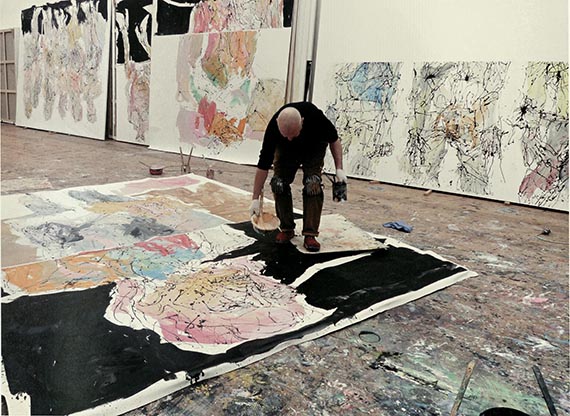
The monumental works are created on the floor so that the fairly fluid paint does not leave streaks on the canvas. Baselitz crawls around the works or stands in the middle of the canvas; he paints the forms that come to mind—without the option to step back and assess the overall result from time to time.
The size of the works plays a major role. Standing before these paintings, viewers are compelled to engage with the lower part of the composition first because of its overwhelming monumentality. At the same time, the lower part of the painting features an unusually free, highly dynamic, and nearly abstract style; the expressive power of the upper half unfolds in the larger-than-life head gazing into the distance, the bold, vibrant colors, and the stark contrast with the dark background.
“Many of the colors are incredibly bright against the white ground. They strike your eyes with a bang,” comments art historian and curator Robert Fleck on this series of works.
Artistic Contrasts and Relentless Self-Challenge
Contradictions and contrasts lie at the heart of Georg Baselitz’s art, as in this painting: monochromatic tones and vibrant colors, flat paint application and expressive lines, monumentality and intricate detail, reflection and innovation.
For about a decade, this critical reflection and self-analysis have occupied much of Baselitz’s painterly practice. “I try to breathe new life into everything I have created in the past. This is a nostalgic, highly sentimental endeavor. I approach it quite deliberately, drawing on all my intellectual faculties” (quoted from: ibid., p. 15)
The artist’s works reflect this “relentless self-challenge” and make “his simultaneous movement of ‘always forward’ and ‘always back’ almost physically tangible” (Cornelius Tittel, Georg Baselitz. Der malende Partisan, in: Welt online, Nov. 2, 2021)
In recent years, the artist’s outstanding body of work has been honored with comprehensive, retrospective solo exhibitions at the world’s most renowned museums and institutions, including the Haus der Kunst in Munich, the Fondation Beyeler in Riehen/Basel, the Munchmuseet in Oslo, White Cube in London, the Kunsthistorisches Museum in Vienna, and the Centre Georges Pompidou in Paris. Currently, the Pinakothek der Moderne in Munich, among others, shows a comprehensive retrospective exploring the complex evolution of his work (through November 8). Next year, the Museum Frieder Burda in Baden-Baden will host a comprehensive solo exhibition in honor of the recently deceased artist. [CH]
With a versatile, radical artistic output spanning six decades, the late Georg Baselitz ranks among the most significant and successful German painters of his generation.
In the mid-20th century, his provocative, expressive paintings significantly contributed to the renewal of figurative post-war painting. In the years and decades that followed, Baselitz subjected his painting to constant evolution, resulting in an oeuvre of great thematic and stylistic richness, in which the human figure—in its most diverse forms and often entirely devoid of a narrative dimension—always plays a central role, both in terms of subject matter and concept.
Among his most significant early creative phases and exemplary key works are, among others, the so-called “Hero Paintings” and “Fraktur Paintings” of the 1960s, followed by the first upside-down paintings in 1969. Baselitz then worked on successive groups of works in which he experimented with great mastery using new painterly techniques and different aesthetic approaches. He drew inspiration from history, European and American art, and his extensive knowledge of countless influential artists, including Edvard Munch, Otto Dix, and Willem de Kooning. Later, he created the so-called “Russian Paintings” as well as self-reflexive series such as the “Remix” series, to which the present work belongs.
Remix: Retrospective, Self-Criticism, and Radical Innovation
Since 2005, Georg Baselitz has explored the idea of taking visual motifs from his 1960s paintings and drawings, critically reinterpreting them, and transforming them into entirely new works. With the help of photocopies, drawings, and illustrations from catalogs, the artist delves into the past to bring his own works into the present by employing different painting techniques and a mindset that has been shaped by five decades of experience. “Baselitz’s visual universe [functions] like a hall of mirrors, in which his own images merge with art-historical models to form new pictorial compositions.” (Press release for the retrospective “Georg Baselitz” at the Fondation Beyeler, Riehen)
The “Fraktur” paintings from 1965–1968 are based on drawings that the artist said depict his wife, Elke Kretzschmar. At the time, he wasn’t entirely sure; today, he knows it to be fact.
“Back then, I had the feeling that these drawings had only partially become pictures. Many of them didn’t seem to work as paintings. Today, I take these old drawings out again and tell myself: This is worth it. You absolutely have to do this. It has to become a larger painting,” explains the artist (quoted from: Exhibition catalog Georg Baselitz: New Paintings and a Sculpture, Gagosian Gallery, New York 2012, p. 12).
Georg Baselitz, Untitled, 1966, pencil, charcoal, ink and ink wash on paper. © Georg Baselitz 2026
While painting, Baselitz holds a photograph of the original work in his left hand and uses it as a guide during the creative process. In these “Remix” paintings, he contrasts the powerful brushwork and saturated paint application characteristic of the 1960s with the lucid transparency of paint drippings, which he “mixes” on a canvas divided into two halves, using bold, even metallic-glossy colors that he applies generously, along with a playful internal drawing. Baselitz explains: “On top of what once possessed its own inner coherence, I apply a different method, at times even a different style or other, very distinct colors, or sometimes I just blur it with white and add a drawing on top. I try to preserve one thing: the original impulse. A different painter created these earlier works. Certainly, it was me, but in a different frame of mind and with a different intention. It is impossible to recapture that forty-five years later. One can only look at the painting that was created back then. I begin to reflect on this painting, to return to it in my mind. And that is how the new painting comes into being.” (Georg Baselitz on this series of works, quoted from: ibid., p. 9)
A Painting Composed of Two Halves
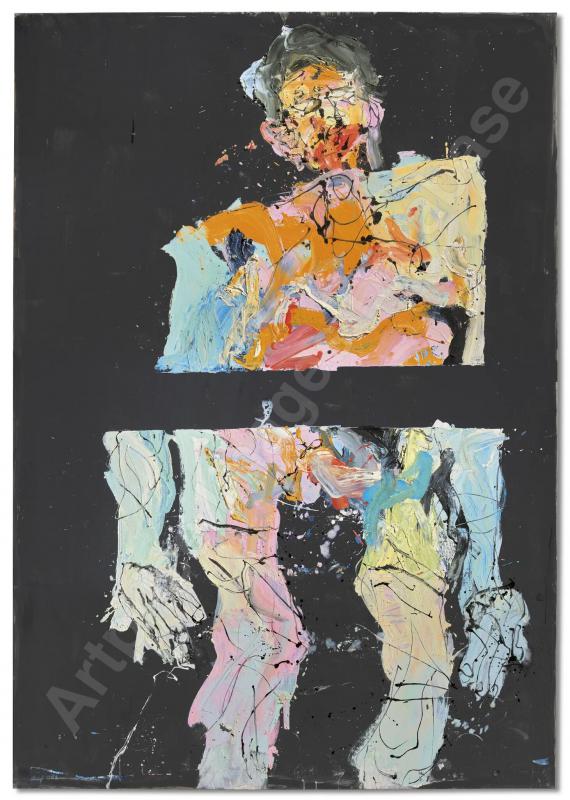
The painting offered here, part of the “Remix” series, was created as part of a small series of works in 2011 at the artist’s then-new studio on Lake Ammersee. Despite critical self-reflection and an innovative, at times experimental approach, Baselitz initially remained somewhat true to himself: a single, central figure dominates the canvas. In a first step, he paints the figure’s head, the beginning of each new painting.
The monumental works are created on the floor so that the fairly fluid paint does not leave streaks on the canvas. Baselitz crawls around the works or stands in the middle of the canvas; he paints the forms that come to mind—without the option to step back and assess the overall result from time to time.
The size of the works plays a major role. Standing before these paintings, viewers are compelled to engage with the lower part of the composition first because of its overwhelming monumentality. At the same time, the lower part of the painting features an unusually free, highly dynamic, and nearly abstract style; the expressive power of the upper half unfolds in the larger-than-life head gazing into the distance, the bold, vibrant colors, and the stark contrast with the dark background.
“Many of the colors are incredibly bright against the white ground. They strike your eyes with a bang,” comments art historian and curator Robert Fleck on this series of works.
The painting on offer in Georg Baselitz’s studio, 2011. © Elke Baselitz 2026
Artistic Contrasts and Relentless Self-Challenge
Contradictions and contrasts lie at the heart of Georg Baselitz’s art, as in this painting: monochromatic tones and vibrant colors, flat paint application and expressive lines, monumentality and intricate detail, reflection and innovation.
For about a decade, this critical reflection and self-analysis have occupied much of Baselitz’s painterly practice. “I try to breathe new life into everything I have created in the past. This is a nostalgic, highly sentimental endeavor. I approach it quite deliberately, drawing on all my intellectual faculties” (quoted from: ibid., p. 15)
The artist’s works reflect this “relentless self-challenge” and make “his simultaneous movement of ‘always forward’ and ‘always back’ almost physically tangible” (Cornelius Tittel, Georg Baselitz. Der malende Partisan, in: Welt online, Nov. 2, 2021)
In recent years, the artist’s outstanding body of work has been honored with comprehensive, retrospective solo exhibitions at the world’s most renowned museums and institutions, including the Haus der Kunst in Munich, the Fondation Beyeler in Riehen/Basel, the Munchmuseet in Oslo, White Cube in London, the Kunsthistorisches Museum in Vienna, and the Centre Georges Pompidou in Paris. Currently, the Pinakothek der Moderne in Munich, among others, shows a comprehensive retrospective exploring the complex evolution of his work (through November 8). Next year, the Museum Frieder Burda in Baden-Baden will host a comprehensive solo exhibition in honor of the recently deceased artist. [CH]

Commissione, tassa e diritti di seguito
Quest'oggetto viene offerto con regime fiscale normale.
Calcolo regime fiscale normale:
Prezzo di aggiudicazione fino a 2.000.000 €: supplemento del 29%. Prezzo di aggiudicazione superiore a 2.000.000 €: Parte del prezzo fino a 2.000.000 € supplemento del 29 %, parte del prezzo che supera i 2.000.000 € supplemento del 23%.
Prezzo di aggiudicazione superiore a 4.000.000 €: Parte del prezzo che supera i 4.000.000 € supplemento del 15%.
L'IVA prevista dalla legge è pari al 7 % sulla somma del prezzo di aggiudicazione e del supplemento.
Calcolo diritti di seguito:
Per le opere originali di arti figurative e fotografie di artisti viventi o deceduti da meno di 70 anni soggette al diritto di seguito, in tutti i casi suddetti viene riscossa in aggiunta, a liquidazione della compensazione del diritto di seguito dovuto dalla casa d'aste ai sensi del § 26 della legge tedesca sul diritto d'autore (Urheberrechtsgesetz, UrhG), una compensazione del diritto di seguito con le percentuali indicate nel § 26 2° comma UrhG, che attualmente sono le seguenti:
4 per cento della parte del ricavo della vendita da 400,00 euro a 50.000 euro,
un altro 3 per cento della parte del ricavo della vendita da 50.000,01 a 200.000 Euro,
un altro 1 per cento della parte del ricavo della vendita da 200.000,01 a 350.000 Euro,
un altro 0,5 per cento della parte del ricavo della vendita da 350.000,01 a 500.000 euro e
un altro 0,25 per cento della parte del ricavo della vendita superiore a 500.000 euro.
L’importo complessivo della compensazione del diritto di seguito derivante da una rivendita è pari al massimo a 12.500 euro.