


Video
Cornice
Altre immagini
Altre immagini
Altre immagini
Altre immagini
Raumbeispiel
43
Pierre Soulages
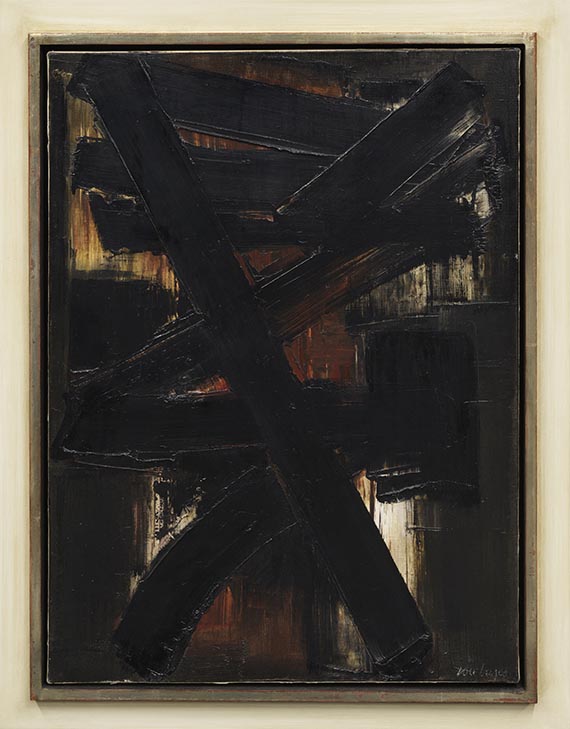
Peinture 81 x 60 cm, 2 mai 1957, 1957.
Olio su tela
Stima: € 1,000,000 / $ 1,120,000
43
Pierre Soulages
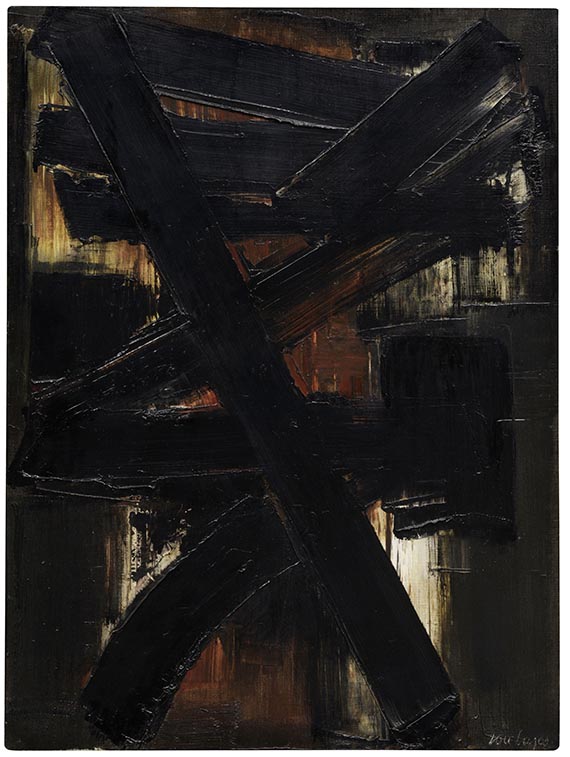
Peinture 81 x 60 cm, 2 mai 1957, 1957.
Olio su tela
Stima: € 1,000,000 / $ 1,120,000
Pierre Soulages
1919 - 2022
Peinture 81 x 60 cm, 2 mai 1957. 1957.
Oil on canvas.
Signed in the lower right. Signed and dated, as well as inscribed “ARIEL” and “1507” in handwriting, on the stretcher. 81 x 60 cm (31.8 x 23.6 in).
• ICON OF FRENCH POST-WAR ART Honored as the most significant French representative of post-war abstract painting with a solo exhibition at the Louvre in 2019 —an honor previously bestowed only on Picasso and Chagall.
• KEY PERIOD Created during the pivotal 1950s, when Soulages developed his distinctive visual language and achieved his international breakthrough— documenta in 1955 and 1959.
• COLOR CONTRAST Deep black and luminous reddish-brown combine to form a dynamic composition of extraordinary depth.
• FORESHADOWING OUTRENOIR The intense exploration of black, light, and surface effects already foreshadows the Outrenoir style developed beginning in 1979.
• RARITY Significant paintings from the 1950s are highly sought after internationally and rarely appear on the international auction market.
PROVENANCE: Private collection, Southern Germany.
From a Swiss corporate collection (2012, Ketterer Kunst).
EXHIBITION: Galerie de France, Paris, 1957.
LITERATURE: Pierre Encrevé, Soulages. L'œuvre complet. Peintures, vol. 1, 1946–1959, Seuil, Paris 1994, CR no. 300 (with color illustration).
- -
Ketterer Kunst, Munich, Auction 393, Postwar/Contemporary Art, September 6, 2012, lot 219 (with color illustration).
“When we speak of light, I am interested in the mental field the observer touches. It concerns everything that takes place in our imagination or within us.”
Pierre Soulages in an interview with Heinz-Norbert Jocks in: Kunstforum International, vol. 141, 1998, pp. 250ff
“Oh, so you’re the painter of those big black paintings. They’re the highlights of the salon.
Francis Picabia, 1947
Called up: December 4, 2026 - ca. 18.24 h +/- 20 min.
Pierre Soulages ranks among the most significant figures of European post-war abstraction. With his oeuvre, he has carved out a unique position that stands apart from both Informel Art and Lyrical Abstraction.
The Path to Success: “Ah, you’re the painter of the large black paintings. Those are the best at the Salon” (F. Picabia, 1947)
Born in Rodez in 1919, Pierre Soulages decided to pursue an artistic career early on. Despite passing the entrance exam, however, he did not enroll at the École des Beaux-Arts in Paris in the early 1930s; the institution’s outdated artistic environment deterred him. Only after the war—which he survived under a false identity as a winegrower—was he able to truly devote himself to his art. Starting in 1946, he devoted himself exclusively to painting. From the very beginning, his works featured predominantly dark colors; beginning in 1947, he used walnut-shell stain, a technique that would remain characteristic of his work. At the 1947 Salon des Surindependants, he exhibited “Broux des noix sur papier, 74 x 47.5 cm, 1947.” He later met Francis Picabia and Hans Hartung, with whom he remained close friends.
“Ah, you are the painter of the large black paintings. Those are the best at the Salon,” was Picabia’s assessment of the works exhibited at the Salon des Surindependants. Picabia also predicted that his young colleague would face significant opposition in artistic circles due to this approach.
As early as the following year, further international exhibitions followed, and James Johnson Sweeney (curator of the Museum of Modern Art from 1935 to 1946; director of the Solomon R. Guggenheim Museum in New York from 1952 to 1960) visited Soulages in his studio. He was enthusiastic about Soulages’ walnut-stained paintings and became one of his most dedicated patrons. This broke the ice, and further major exhibitions followed at leading galleries throughout Europe, the U.S., and Asia.
In 1954, Soulages’s first solo exhibition took place at Sam Kootz Gallery in New York, which also represented Mark Rothko, Robert Motherwell, and Willem de Kooning. Sam Kootz reported enthusiastically, “I have not had such an enthusiastic reception since my first postwar Picasso show in 1947, when all the paintings were sold on the first day” (S. Kootz, quoted in Pierre Encreve,*Soulages. Les peintures 1946–2006, Paris 1994, 4th ed. 2007, p. 82).
In France, Pierre Soulages was represented by Galerie de France in Paris; the present “Peinture 81 x 60 cm, May 2, 1957” was also exhibited there the year it was created.
It was not until a year later, in 1958, that he traveled to Cambodia, Thailand, and Japan, where he could pursue his interest in Asian calligraphy. This element is already hinted at in our painting.
Setbacks and Successes
The seemingly smooth rise to success mentioned above was in fact a hard-won struggle. With his conception of art—free of any existentialist fervor—Pierre Soulages occupied a difficult position in Paris during the 1950s and 1960s. The spirit of the times favored Art Informel, Tachism, and Lyrical Abstraction. Yet Pierre Soulages did not aim to translate emotion and sensation into a gestural visual language.
He worked towards his very own approach to art, the radical nature of which is perfectly illustrated by an anecdote from his childhood: “Back then, I’d dip my brush into a barrel (sic) of black ink and make random strokes. One day, an adult friend asked me what I was doing, and I said, ‘A snowy landscape,’ at which point she burst out laughing.” (P. Soulages in an interview with Heinz-Norbert Jocks, kunstforum-international, vol. 141, 1998, pp. 250ff.)
The main distinction from his contemporaries was that he did not want to create intellectual art steeped in philosophy and theory. His primary concern was exploring techniques. Even during his early visits to museums, where he studied the art of Picasso or Cézanne, he had always been interested in the painters’ techniques, “which made me aware of the close relationship between painting technique and the art that results from it.” (ibid.) The variety of tools he used to apply paint to the canvas speaks volumes: a wide range of broad brushes, often with stiff bristles. By using a stain made from green walnut shells, he also forged his own unique path in the choice of painting materials. As a glazing, water-based ink, “broux de noix” was already used by Claude Lorrain and Rembrandt. Soulages mixes it with other substances to increase its viscosity, creating a deeper material structure. The color range varies from reddish to brown. He has used it as a paint since 1947. Depending on the composition, the transparency changes, and so does the surface texture. The stain can be slightly viscous, allowing the subtle relief of the brushstrokes to remain even after drying. Thanks to the material’s lucidity, this creates not only a fascinating surface but also a sense of spatial depth as light penetrates the painting surface.
It is also important to note the consistency of the titles the artist uses throughout his entire body of work, which he chose intentionally: technique, dimensions, and date of creation. These are the elements he deemed necessary and meaningful for defining and designating his works.
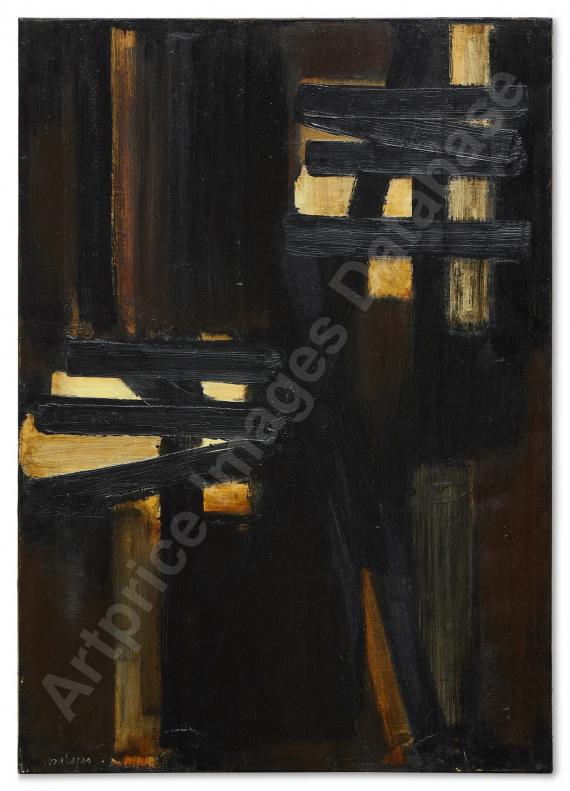
Peinture 81 x 60 cm, 2 mai 1957"
Pierre Soulages, closely associated with the invention of the art of “Outre-noir,” focused on the subtle contrast between dark, brownish colors—sometimes tinged with black—and a translucent, light background. Through his choice of the brush as the tool for applying the paint, the creation of the surface takes center stage. This canvas is defined by broad black brushstrokes that extend across the light, deliberately left-blank background: dark paint rests on top of lighter layers. The pattern, which lies diagonally and transversely over the underlying, flatter layers—reminiscent of Japanese characters —reveals the stroke’s trajectory and the moments of the brushstroke’s beginning and end in subtle relief. Black does not appear as a uniform hue, but rather in varying shades—from deep darkness to a translucent, flowing transparency. The generously applied color fields create a dynamic harmony of vertical and horizontal forms. This controlled dynamism underscores the importance of deliberate organization of the picture plane. In our painting “Peinture 81 x 60 cm, 2 mai 1957,” a reduced color palette comes to the fore. A solid brown-black stands out against a background ranging from reddish-brown to delicate white. Pierre Soulages attached particular importance to the texture of the paint: The raised surface of the painting transcends mere color value; with its surface relief, it captures the light and constantly creates new visual impressions. In this work, Soulages was already on the path that would ultimately lead to the complex black works of his late period. The paint application does not depict color itself but reveals its diverse material, tactile, and light-reflecting qualities. The viewer’s eye, the prevailing lighting conditions, and ultimately the viewer’s position integrate the canvas into a comprehensive system. [EH]
The Path to Success: “Ah, you’re the painter of the large black paintings. Those are the best at the Salon” (F. Picabia, 1947)
Born in Rodez in 1919, Pierre Soulages decided to pursue an artistic career early on. Despite passing the entrance exam, however, he did not enroll at the École des Beaux-Arts in Paris in the early 1930s; the institution’s outdated artistic environment deterred him. Only after the war—which he survived under a false identity as a winegrower—was he able to truly devote himself to his art. Starting in 1946, he devoted himself exclusively to painting. From the very beginning, his works featured predominantly dark colors; beginning in 1947, he used walnut-shell stain, a technique that would remain characteristic of his work. At the 1947 Salon des Surindependants, he exhibited “Broux des noix sur papier, 74 x 47.5 cm, 1947.” He later met Francis Picabia and Hans Hartung, with whom he remained close friends.
“Ah, you are the painter of the large black paintings. Those are the best at the Salon,” was Picabia’s assessment of the works exhibited at the Salon des Surindependants. Picabia also predicted that his young colleague would face significant opposition in artistic circles due to this approach.
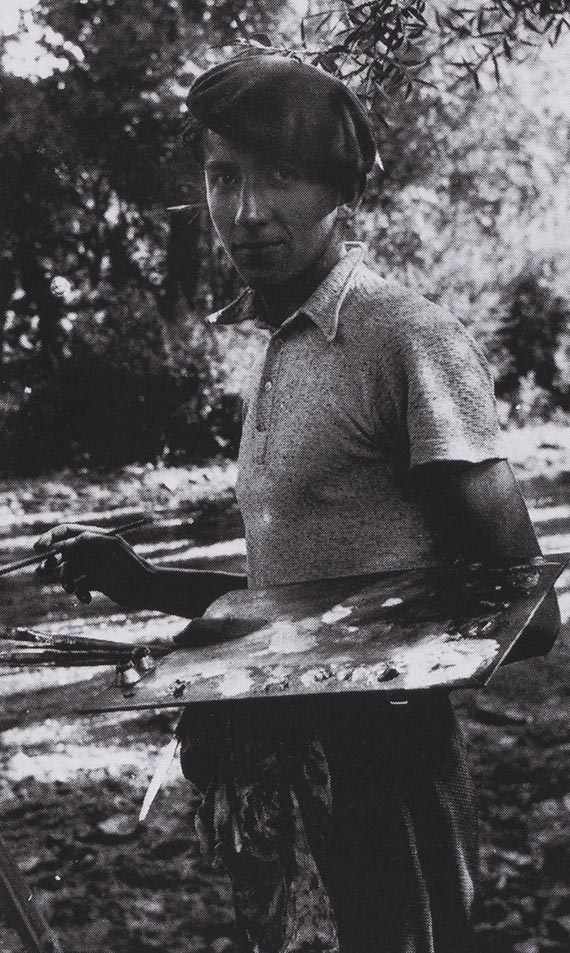
Pierre Soulages in the area of Rodez, 1935-36, photo: unknown.
As early as the following year, further international exhibitions followed, and James Johnson Sweeney (curator of the Museum of Modern Art from 1935 to 1946; director of the Solomon R. Guggenheim Museum in New York from 1952 to 1960) visited Soulages in his studio. He was enthusiastic about Soulages’ walnut-stained paintings and became one of his most dedicated patrons. This broke the ice, and further major exhibitions followed at leading galleries throughout Europe, the U.S., and Asia.
In 1954, Soulages’s first solo exhibition took place at Sam Kootz Gallery in New York, which also represented Mark Rothko, Robert Motherwell, and Willem de Kooning. Sam Kootz reported enthusiastically, “I have not had such an enthusiastic reception since my first postwar Picasso show in 1947, when all the paintings were sold on the first day” (S. Kootz, quoted in Pierre Encreve,*Soulages. Les peintures 1946–2006, Paris 1994, 4th ed. 2007, p. 82).
In France, Pierre Soulages was represented by Galerie de France in Paris; the present “Peinture 81 x 60 cm, May 2, 1957” was also exhibited there the year it was created.
It was not until a year later, in 1958, that he traveled to Cambodia, Thailand, and Japan, where he could pursue his interest in Asian calligraphy. This element is already hinted at in our painting.
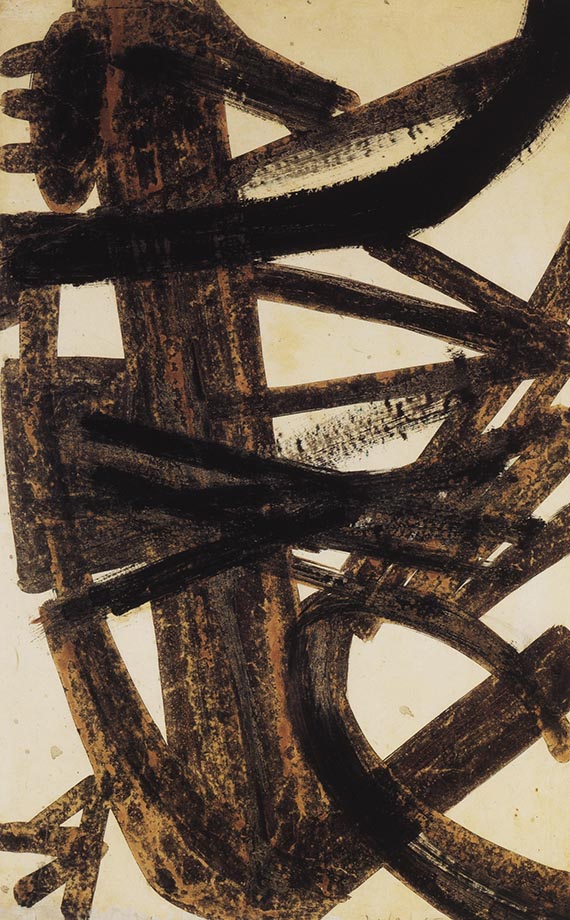
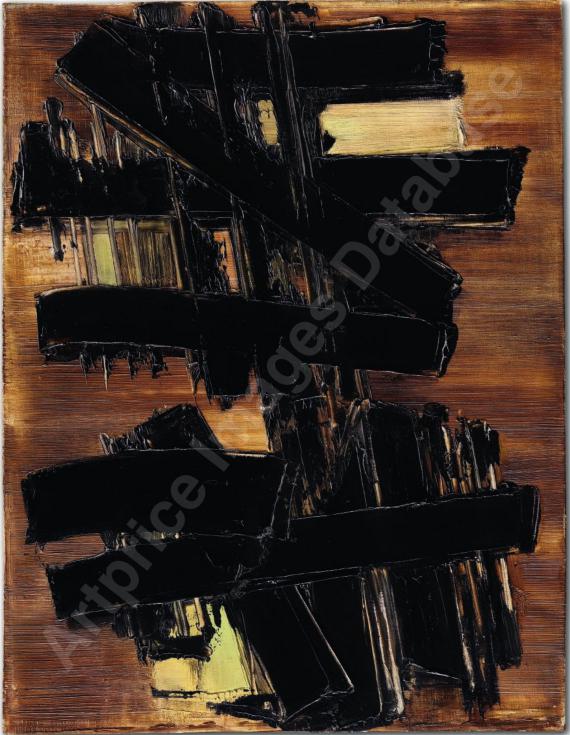
Pierre Soulages, Brou de noix et huile sur papier, 74 x 47,5 cm, 1947, Museé Soulages, Rodez. © VG Bild-Kunst, Bonn 2026
Setbacks and Successes
The seemingly smooth rise to success mentioned above was in fact a hard-won struggle. With his conception of art—free of any existentialist fervor—Pierre Soulages occupied a difficult position in Paris during the 1950s and 1960s. The spirit of the times favored Art Informel, Tachism, and Lyrical Abstraction. Yet Pierre Soulages did not aim to translate emotion and sensation into a gestural visual language.
He worked towards his very own approach to art, the radical nature of which is perfectly illustrated by an anecdote from his childhood: “Back then, I’d dip my brush into a barrel (sic) of black ink and make random strokes. One day, an adult friend asked me what I was doing, and I said, ‘A snowy landscape,’ at which point she burst out laughing.” (P. Soulages in an interview with Heinz-Norbert Jocks, kunstforum-international, vol. 141, 1998, pp. 250ff.)
The main distinction from his contemporaries was that he did not want to create intellectual art steeped in philosophy and theory. His primary concern was exploring techniques. Even during his early visits to museums, where he studied the art of Picasso or Cézanne, he had always been interested in the painters’ techniques, “which made me aware of the close relationship between painting technique and the art that results from it.” (ibid.) The variety of tools he used to apply paint to the canvas speaks volumes: a wide range of broad brushes, often with stiff bristles. By using a stain made from green walnut shells, he also forged his own unique path in the choice of painting materials. As a glazing, water-based ink, “broux de noix” was already used by Claude Lorrain and Rembrandt. Soulages mixes it with other substances to increase its viscosity, creating a deeper material structure. The color range varies from reddish to brown. He has used it as a paint since 1947. Depending on the composition, the transparency changes, and so does the surface texture. The stain can be slightly viscous, allowing the subtle relief of the brushstrokes to remain even after drying. Thanks to the material’s lucidity, this creates not only a fascinating surface but also a sense of spatial depth as light penetrates the painting surface.
It is also important to note the consistency of the titles the artist uses throughout his entire body of work, which he chose intentionally: technique, dimensions, and date of creation. These are the elements he deemed necessary and meaningful for defining and designating his works.
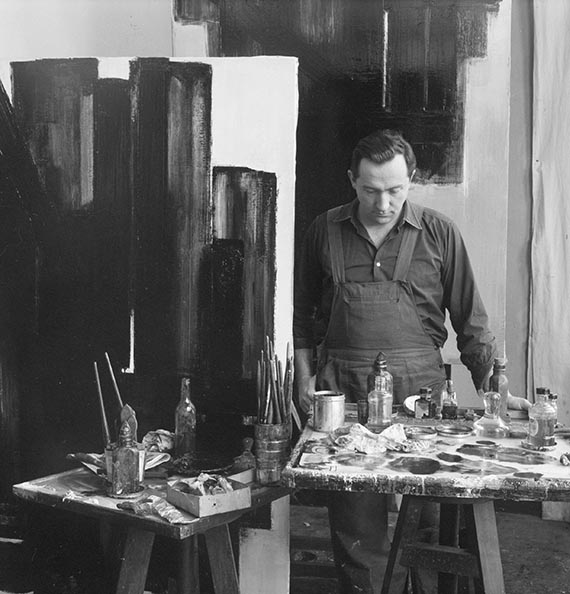
Soulages in his studio, 1954, photo: Denise Colomb. © VG Bild-Kunst, Bonn 2026
Peinture 81 x 60 cm, 2 mai 1957"
Pierre Soulages, closely associated with the invention of the art of “Outre-noir,” focused on the subtle contrast between dark, brownish colors—sometimes tinged with black—and a translucent, light background. Through his choice of the brush as the tool for applying the paint, the creation of the surface takes center stage. This canvas is defined by broad black brushstrokes that extend across the light, deliberately left-blank background: dark paint rests on top of lighter layers. The pattern, which lies diagonally and transversely over the underlying, flatter layers—reminiscent of Japanese characters —reveals the stroke’s trajectory and the moments of the brushstroke’s beginning and end in subtle relief. Black does not appear as a uniform hue, but rather in varying shades—from deep darkness to a translucent, flowing transparency. The generously applied color fields create a dynamic harmony of vertical and horizontal forms. This controlled dynamism underscores the importance of deliberate organization of the picture plane. In our painting “Peinture 81 x 60 cm, 2 mai 1957,” a reduced color palette comes to the fore. A solid brown-black stands out against a background ranging from reddish-brown to delicate white. Pierre Soulages attached particular importance to the texture of the paint: The raised surface of the painting transcends mere color value; with its surface relief, it captures the light and constantly creates new visual impressions. In this work, Soulages was already on the path that would ultimately lead to the complex black works of his late period. The paint application does not depict color itself but reveals its diverse material, tactile, and light-reflecting qualities. The viewer’s eye, the prevailing lighting conditions, and ultimately the viewer’s position integrate the canvas into a comprehensive system. [EH]

Commissione, tassa e diritti di seguito
Quest'oggetto viene offerto con regime fiscale normale.
Calcolo regime fiscale normale:
Prezzo di aggiudicazione fino a 2.000.000 €: supplemento del 29%. Prezzo di aggiudicazione superiore a 2.000.000 €: Parte del prezzo fino a 2.000.000 € supplemento del 29 %, parte del prezzo che supera i 2.000.000 € supplemento del 23%.
Prezzo di aggiudicazione superiore a 4.000.000 €: Parte del prezzo che supera i 4.000.000 € supplemento del 15%.
L'IVA prevista dalla legge è pari al 7 % sulla somma del prezzo di aggiudicazione e del supplemento.
Calcolo diritti di seguito:
Per le opere originali di arti figurative e fotografie di artisti viventi o deceduti da meno di 70 anni soggette al diritto di seguito, in tutti i casi suddetti viene riscossa in aggiunta, a liquidazione della compensazione del diritto di seguito dovuto dalla casa d'aste ai sensi del § 26 della legge tedesca sul diritto d'autore (Urheberrechtsgesetz, UrhG), una compensazione del diritto di seguito con le percentuali indicate nel § 26 2° comma UrhG, che attualmente sono le seguenti:
4 per cento della parte del ricavo della vendita da 400,00 euro a 50.000 euro,
un altro 3 per cento della parte del ricavo della vendita da 50.000,01 a 200.000 Euro,
un altro 1 per cento della parte del ricavo della vendita da 200.000,01 a 350.000 Euro,
un altro 0,5 per cento della parte del ricavo della vendita da 350.000,01 a 500.000 euro e
un altro 0,25 per cento della parte del ricavo della vendita superiore a 500.000 euro.
L’importo complessivo della compensazione del diritto di seguito derivante da una rivendita è pari al massimo a 12.500 euro.