


Asta: 606 / Evening Sale del 12 giugno 2026 a Monaco di Baviera → Lot 126000271
Cornice
126000271
Ernst Ludwig Kirchner
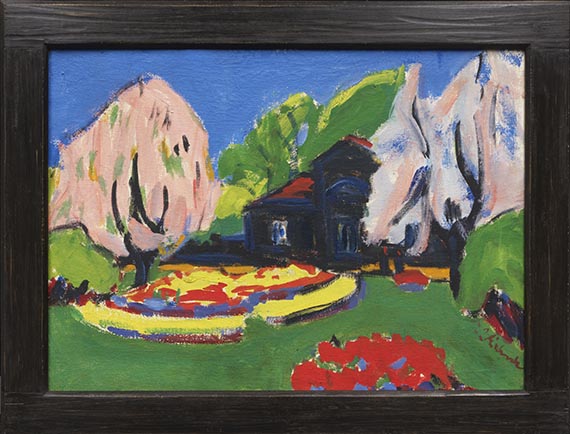
Landschaft mit Haus (Torhaus an der Hauptallee des Großen Gartens in Dresden), 1910.
Olio su tela
Stima: € 800,000 / $ 936,000
Le informationi sulla commissione, le tasse e il diritto di seguito saranno disponibili quattro settimane prima dell´asta.
126000271
Ernst Ludwig Kirchner
Landschaft mit Haus (Torhaus an der Hauptallee des Großen Gartens in Dresden), 1910.
Olio su tela
Stima: € 800,000 / $ 936,000
Le informationi sulla commissione, le tasse e il diritto di seguito saranno disponibili quattro settimane prima dell´asta.
Ernst Ludwig Kirchner
1880 - 1938
Landschaft mit Haus (Torhaus an der Hauptallee des Großen Gartens in Dresden). 1910.
Oil on canvas.
Signed in the lower right. 51 x 70.5 cm (20 x 27.7 in).
The work is mentioned in the artist's Photoalbum I (photo 191).
• Dresden, the birthplace of German Expressionism: in 1905, E. L. Kirchner was among the founding members of the legendary artists' group “Die Brücke” (1905–1913).
• Pure Expressionism: the motifs emerge from pure, high-contrast colors.
• Outstanding and consistent provenance: once part of the collection of Dr. Ludwig and Dr. Otto Binswanger, the artist’s physicians at the Bellevue Sanatorium in Kreuzlingen, and their descendants.
• With bold brushstrokes and radical simplification of forms, Kirchner transforms the colors of spring into a masterpiece of Expressionist painting.
• Today, paintings of this quality are almost exclusively held by museums.
The work is documented at the Ernst Ludwig Kirchner Archive, Wichtrach/Bern.
PROVENANCE: Dr. Ludwig Binswanger and Dr. Otto Binswanger, Kreuzlingen (purchased directly from the artist, after 1918, subsequently in the family’s possession).
M. Binswanger-Huber, Bern (inherited).
Private collection, Southern Germany (acquired from the above in 2005, Grisebach, Berlin).
EXHIBITION: E. L. Kirchner und Rot-Blau, Kunsthalle Basel, 1967, cat. no. 17.
Im Farbenrausch. Munch, Matisse und die Expressionisten, Museum Folkwang, Essen, Sept. 29, 2012–Jan. 13, 2013, cat. no. 73 (illustrated on p. 171).
LITERATURE: Donald E. Gordon, Ernst Ludwig Kirchner, Munich 1968, pp. 69 and 292, CR no. 127 (illustrated in black and white).
- -
Albert Schoop, Ernst Ludwig Kirchner in Thurgau. Die 10 Monate in Kreuzlingen 1917–1918, Bern 1992, p. 64.
Konstanze Rudert, Dresdner Motive in den Werken der Künstlergemeinschaft Brücke (based on Bernd Hünlich’s topographical-critical inventory), in: Exhibition catalog Die Brücke in Dresden 1905–1911, Galerie Neue Meister, Staatliche Kunstsammlungen, Dresden, Cologne 2001/2002, p. 382 (illustrated).
Hans Delfs (ed.), Ernst Ludwig Kirchner. Der gesamte Briefwechsel - “Die absolute Wahrheit, so wie ich sie fühle,” Zurich 2010, nos. 507 and 516.
Villa Grisebach, Berlin, 125th Auction, Selected Works, June 3, 2005, lot 18 (illustrated).
1880 - 1938
Landschaft mit Haus (Torhaus an der Hauptallee des Großen Gartens in Dresden). 1910.
Oil on canvas.
Signed in the lower right. 51 x 70.5 cm (20 x 27.7 in).
The work is mentioned in the artist's Photoalbum I (photo 191).
• Dresden, the birthplace of German Expressionism: in 1905, E. L. Kirchner was among the founding members of the legendary artists' group “Die Brücke” (1905–1913).
• Pure Expressionism: the motifs emerge from pure, high-contrast colors.
• Outstanding and consistent provenance: once part of the collection of Dr. Ludwig and Dr. Otto Binswanger, the artist’s physicians at the Bellevue Sanatorium in Kreuzlingen, and their descendants.
• With bold brushstrokes and radical simplification of forms, Kirchner transforms the colors of spring into a masterpiece of Expressionist painting.
• Today, paintings of this quality are almost exclusively held by museums.
The work is documented at the Ernst Ludwig Kirchner Archive, Wichtrach/Bern.
PROVENANCE: Dr. Ludwig Binswanger and Dr. Otto Binswanger, Kreuzlingen (purchased directly from the artist, after 1918, subsequently in the family’s possession).
M. Binswanger-Huber, Bern (inherited).
Private collection, Southern Germany (acquired from the above in 2005, Grisebach, Berlin).
EXHIBITION: E. L. Kirchner und Rot-Blau, Kunsthalle Basel, 1967, cat. no. 17.
Im Farbenrausch. Munch, Matisse und die Expressionisten, Museum Folkwang, Essen, Sept. 29, 2012–Jan. 13, 2013, cat. no. 73 (illustrated on p. 171).
LITERATURE: Donald E. Gordon, Ernst Ludwig Kirchner, Munich 1968, pp. 69 and 292, CR no. 127 (illustrated in black and white).
- -
Albert Schoop, Ernst Ludwig Kirchner in Thurgau. Die 10 Monate in Kreuzlingen 1917–1918, Bern 1992, p. 64.
Konstanze Rudert, Dresdner Motive in den Werken der Künstlergemeinschaft Brücke (based on Bernd Hünlich’s topographical-critical inventory), in: Exhibition catalog Die Brücke in Dresden 1905–1911, Galerie Neue Meister, Staatliche Kunstsammlungen, Dresden, Cologne 2001/2002, p. 382 (illustrated).
Hans Delfs (ed.), Ernst Ludwig Kirchner. Der gesamte Briefwechsel - “Die absolute Wahrheit, so wie ich sie fühle,” Zurich 2010, nos. 507 and 516.
Villa Grisebach, Berlin, 125th Auction, Selected Works, June 3, 2005, lot 18 (illustrated).
Dresden: Birthplace of the famous “Brücke” artist group
In June 1905, Ernst Ludwig Kirchner, Fritz Bleyl, Erich Heckel, and Karl Schmidt-Rottluff founded the artist group “Brücke”. At this time, Kirchner was keenly interested in the contemporary artistic currents in France, including the Post-Impressionists, the “Nabis”, and the “Fauves” around Henri Matisse, and he studied the paintings of Edvard Munch, as well as those of Vincent van Gogh, who had died just a few years earlier. In November 1905, Galerie Arnold in Dresden presented a retrospective exhibition of over 50 works by van Gogh, organized by the Berlin gallerist Paul Cassirer. Until then, van Gogh’s vibrant works were likely known to most people in Germany—including E. L. Kirchner—only through black-and-white reproductions. Now the full force and expressive power of his paintings became clear—a revelation and a pivotal experience, even for the young “Brücke” artists. Enthralled by the wild, primal quality of his style, the freedom of form, and the bold color palette, the atmosphere in the “Brücke” studio also became noticeably more unrestrained and chaotic: Art became part of everyday life; they often worked together in the studio or outdoors. The works became more dynamic and direct, born of the moment, and in their paintings, the young artists began to work with colors applied directly from the tube to the canvas without prior mixing: “Anyone who immediately and authentically conveys what drives them to create belongs to us” (from: “Die Brücke” program, quoted from: exhibition catalog Großstadtrausch – Naturidyll. Kirchner: Die Berliner Jahre, Kunsthaus Zürich, Munich 2017, p. 96). Through their collaborative work during these years, the mature “Brücke” style—which remains unmistakable to this day—emerged.
The zenith of the Dresden “Brücke” period
With his determined pursuit of innovation and reform, E. L. Kirchner found his very own Expressionist visual language within the “Brücke” group. Around 1909–10, he succeeded in expressing his artistic goals—the immediate, unadulterated depiction of his own perceptions and personal experiences—brilliantly and compellingly. Using strong, unmixed colors, with radically simplified, effectively distorted, and exaggerated forms, he created free, spontaneous depictions that broke with academic styles rooted in the past and, through their radicalism and innovative distinctiveness, revolutionized 20th-century Modern Art. Significantly, most of E. L. Kirchner’s paintings attributed to 1910 in Gordon’s catalogue raisonné are now in German and international museum collections. Some works have been lost, likely in part due to the war's turmoil. Only about 10 of the paintings created in 1910 have been offered on the international auction market over the past 30 years and have been acquired by private collections.
At the time, Kirchner drew inspiration from his impressions of the city and nature, a changing world caught between tradition, history, and the modern society, as well as from dance and variety shows, the cultural life of Dresden. In particular, contrasting depictions of modern city life and stays in rural settings are recurring themes throughout Kirchner’s entire body of work. In later years, it is the Berlin street scenes and the Fehmarn landscapes that stand in contrast; in Switzerland, it is the mountain panoramas and the dynamic dance and sports scenes. This alternation can also be found in the Dresden “Brücke” years: alongside summer scenes in the countryside and at the Moritzburg Lakes, he created very urban motifs such as “Tram in Dresden” (1909, Staatsgalerie Stuttgart), “Eisenbahnüberführung Dresden-Löbtau” (1910, Galerie Neue Meister, Albertinum, Dresden State Art Collections), or “Bahnhofseinfahrt, Bahnhof Löbtau” (1911/12, Albertina, Vienna).
Kirchner’s graphic skills, his knowledge of urban planning, perspective, scale, size relationships, and proportions, as well as spatial construction and the creation of depth—all of which he acquired while studying architecture at the Royal Saxon Technical University in Dresden before founding the “Brücke” artists’ group—undoubtedly found their way into these paintings.
In vernal colors: “Landschaft mit Haus (Torhaus an der Hauptallee des Großen Gartens in Dresden)”
Kirchner clearly incorporated his knowledge of architecture into the present painting. Hidden behind lush, circular flowerbeds and trees blooming in a wonderful shade of pink, one of the two gatehouses in the Großer Garten in Dresden, built by Gottlob Friedrich Thormeyer (1775–1842) in 1814, lies in the shade.
Kirchner spent the rest of the summer of 1910, which had just begun at the time, at the Moritzburg Lakes with Erich Heckel and Max Pechstein, as well as a group of friends and models; yet during the spring and early summer months, the artist seemed to have taken great pleasure in spending time in the Großer Garten: Some drawings and watercolors depict other areas of the magnificent park, laid out in the 17th century after a French model, including buildings such as the early Baroque palace and the cavalier houses, massive groups of trees, ornamental shrubs, flower beds, and strollers on the avenues. Not far from the warm, dusty bustle of the city, the Großer Garten offered visitors a chance to enjoy the sun and find rest in peaceful, impressive surroundings. In his paintings, Kirchner conveyed this special atmosphere using bright, unmixed colors applied in broad strokes and with bold, dynamic brushwork. Most forms emerge directly from the paint, unfolding freely without defining outlines or contours. Kirchner used dark lines only for the architectural elements and to add graphic accents to the vegetation. Small areas of the white-primed canvas untouched by paint or brush are incorporated into the composition, creating the impression of sunlight shining through the blossoming treetops, lending the scene a vernal lightness and enhancing the brilliance of the colors. He also evokes movement and vibrancy through small figures of strollers in the background and through a foreground that slopes slightly to the right (emphasized by his slanted signature), which draws the viewer directly into the painting through the sophisticated composition and the partially visible flower beds.
With its vibrant colors, a fluid and expressive style, and the striking immediacy of the scene, “Landscape with House (Gatehouse on the Main Avenue of the Grand Garden in Dresden)” is a wonderful example of Kirchner’s unparalleled art and attests to his significant role as one of the most important proponents of German Expressionism.
The Dr. Binswanger Collection
The work has been in possession of the Binswanger family for nearly 100 years. E. L. Kirchner met the prominent psychoanalyst and psychiatrist Dr. Ludwig Binswanger (1881–1966) at the Bellevue Sanatorium in Kreuzlingen on Lake Constance in September 1917, where the artist had checked in on the advice of his patron and confidant, Henry van de Velde. Kirchner remained a patient at the sanatorium, which had been under Dr. Binswanger’s direction since 1910, until the summer of 1918. He made connections, regained strength, and continued to work steadily on his art. The artist quickly developed confidence in his doctor, who was roughly the same age, and clearly found the relationship with Binswanger during these difficult years to be very positive and beneficial. In 1917, he created the two oil paintings, “Dr. Binswanger in Front of a Mountain Landscape” and “The Visit: Mrs. Binswanger” (cf. CR Gordon 499 and 497), and soon after, three woodcuts of the psychiatrist (cf. CR Gercken 880, 899, and 900) and of his family (cf. CR Gercken 873 and 885).
While Kirchner was undergoing treatment in Kreuzlingen, his partner, Erna Schilling, managed his business affairs and personal contacts in Berlin. In January 1918, she sent a collection of eleven paintings from the years 1909 to 1911, including our “Landscape with House (Gatehouse on the Main Avenue of the Grand Garden in Dresden),” to Helene and Dr. Lucius Spengler in Davos, the director of the Davos sanatorium “Schatzalp,” who had already provided medical care for Kirchner in the winter and spring of 1917. She wrote: “Dear Madam, I am pleased to hear the paintings have arrived safely and that you like them. The enclosed list serves as a description. Regarding the prices, please get in touch with Kirchner. “ (Letter 507, Jan. 20, 1918) Shortly thereafter, Erna Schilling also informed Helene Spengler of the corresponding prices for the works: “The prices of the paintings would be: ‘Landscape with White Wall and Village Chapel’ 500 francs, ‘Blooming Trees Against Suburban Landscape with Houses’ 500 francs, ‘Blossoming Trees and Flowers …, Black House’ 450 francs […]“ (Letter 516, Jan. 20, 1918)
The Spenglers and their ”Haus Fontana" in Davos provided important social support in the period following Kirchner’s relocation to Switzerland.
Presumably very soon thereafter, the work found its way—perhaps through an exchange between the two physicians—into the collection of Dr. Ludwig and his uncle Dr. Otto Binswanger in nearby Kreuzlingen on Lake Constance, where it would remain in the hands of the family until 2005. [CH]
In June 1905, Ernst Ludwig Kirchner, Fritz Bleyl, Erich Heckel, and Karl Schmidt-Rottluff founded the artist group “Brücke”. At this time, Kirchner was keenly interested in the contemporary artistic currents in France, including the Post-Impressionists, the “Nabis”, and the “Fauves” around Henri Matisse, and he studied the paintings of Edvard Munch, as well as those of Vincent van Gogh, who had died just a few years earlier. In November 1905, Galerie Arnold in Dresden presented a retrospective exhibition of over 50 works by van Gogh, organized by the Berlin gallerist Paul Cassirer. Until then, van Gogh’s vibrant works were likely known to most people in Germany—including E. L. Kirchner—only through black-and-white reproductions. Now the full force and expressive power of his paintings became clear—a revelation and a pivotal experience, even for the young “Brücke” artists. Enthralled by the wild, primal quality of his style, the freedom of form, and the bold color palette, the atmosphere in the “Brücke” studio also became noticeably more unrestrained and chaotic: Art became part of everyday life; they often worked together in the studio or outdoors. The works became more dynamic and direct, born of the moment, and in their paintings, the young artists began to work with colors applied directly from the tube to the canvas without prior mixing: “Anyone who immediately and authentically conveys what drives them to create belongs to us” (from: “Die Brücke” program, quoted from: exhibition catalog Großstadtrausch – Naturidyll. Kirchner: Die Berliner Jahre, Kunsthaus Zürich, Munich 2017, p. 96). Through their collaborative work during these years, the mature “Brücke” style—which remains unmistakable to this day—emerged.
The zenith of the Dresden “Brücke” period
With his determined pursuit of innovation and reform, E. L. Kirchner found his very own Expressionist visual language within the “Brücke” group. Around 1909–10, he succeeded in expressing his artistic goals—the immediate, unadulterated depiction of his own perceptions and personal experiences—brilliantly and compellingly. Using strong, unmixed colors, with radically simplified, effectively distorted, and exaggerated forms, he created free, spontaneous depictions that broke with academic styles rooted in the past and, through their radicalism and innovative distinctiveness, revolutionized 20th-century Modern Art. Significantly, most of E. L. Kirchner’s paintings attributed to 1910 in Gordon’s catalogue raisonné are now in German and international museum collections. Some works have been lost, likely in part due to the war's turmoil. Only about 10 of the paintings created in 1910 have been offered on the international auction market over the past 30 years and have been acquired by private collections.
At the time, Kirchner drew inspiration from his impressions of the city and nature, a changing world caught between tradition, history, and the modern society, as well as from dance and variety shows, the cultural life of Dresden. In particular, contrasting depictions of modern city life and stays in rural settings are recurring themes throughout Kirchner’s entire body of work. In later years, it is the Berlin street scenes and the Fehmarn landscapes that stand in contrast; in Switzerland, it is the mountain panoramas and the dynamic dance and sports scenes. This alternation can also be found in the Dresden “Brücke” years: alongside summer scenes in the countryside and at the Moritzburg Lakes, he created very urban motifs such as “Tram in Dresden” (1909, Staatsgalerie Stuttgart), “Eisenbahnüberführung Dresden-Löbtau” (1910, Galerie Neue Meister, Albertinum, Dresden State Art Collections), or “Bahnhofseinfahrt, Bahnhof Löbtau” (1911/12, Albertina, Vienna).
Kirchner’s graphic skills, his knowledge of urban planning, perspective, scale, size relationships, and proportions, as well as spatial construction and the creation of depth—all of which he acquired while studying architecture at the Royal Saxon Technical University in Dresden before founding the “Brücke” artists’ group—undoubtedly found their way into these paintings.
In vernal colors: “Landschaft mit Haus (Torhaus an der Hauptallee des Großen Gartens in Dresden)”
Kirchner clearly incorporated his knowledge of architecture into the present painting. Hidden behind lush, circular flowerbeds and trees blooming in a wonderful shade of pink, one of the two gatehouses in the Großer Garten in Dresden, built by Gottlob Friedrich Thormeyer (1775–1842) in 1814, lies in the shade.
Kirchner spent the rest of the summer of 1910, which had just begun at the time, at the Moritzburg Lakes with Erich Heckel and Max Pechstein, as well as a group of friends and models; yet during the spring and early summer months, the artist seemed to have taken great pleasure in spending time in the Großer Garten: Some drawings and watercolors depict other areas of the magnificent park, laid out in the 17th century after a French model, including buildings such as the early Baroque palace and the cavalier houses, massive groups of trees, ornamental shrubs, flower beds, and strollers on the avenues. Not far from the warm, dusty bustle of the city, the Großer Garten offered visitors a chance to enjoy the sun and find rest in peaceful, impressive surroundings. In his paintings, Kirchner conveyed this special atmosphere using bright, unmixed colors applied in broad strokes and with bold, dynamic brushwork. Most forms emerge directly from the paint, unfolding freely without defining outlines or contours. Kirchner used dark lines only for the architectural elements and to add graphic accents to the vegetation. Small areas of the white-primed canvas untouched by paint or brush are incorporated into the composition, creating the impression of sunlight shining through the blossoming treetops, lending the scene a vernal lightness and enhancing the brilliance of the colors. He also evokes movement and vibrancy through small figures of strollers in the background and through a foreground that slopes slightly to the right (emphasized by his slanted signature), which draws the viewer directly into the painting through the sophisticated composition and the partially visible flower beds.
With its vibrant colors, a fluid and expressive style, and the striking immediacy of the scene, “Landscape with House (Gatehouse on the Main Avenue of the Grand Garden in Dresden)” is a wonderful example of Kirchner’s unparalleled art and attests to his significant role as one of the most important proponents of German Expressionism.
The Dr. Binswanger Collection
The work has been in possession of the Binswanger family for nearly 100 years. E. L. Kirchner met the prominent psychoanalyst and psychiatrist Dr. Ludwig Binswanger (1881–1966) at the Bellevue Sanatorium in Kreuzlingen on Lake Constance in September 1917, where the artist had checked in on the advice of his patron and confidant, Henry van de Velde. Kirchner remained a patient at the sanatorium, which had been under Dr. Binswanger’s direction since 1910, until the summer of 1918. He made connections, regained strength, and continued to work steadily on his art. The artist quickly developed confidence in his doctor, who was roughly the same age, and clearly found the relationship with Binswanger during these difficult years to be very positive and beneficial. In 1917, he created the two oil paintings, “Dr. Binswanger in Front of a Mountain Landscape” and “The Visit: Mrs. Binswanger” (cf. CR Gordon 499 and 497), and soon after, three woodcuts of the psychiatrist (cf. CR Gercken 880, 899, and 900) and of his family (cf. CR Gercken 873 and 885).
While Kirchner was undergoing treatment in Kreuzlingen, his partner, Erna Schilling, managed his business affairs and personal contacts in Berlin. In January 1918, she sent a collection of eleven paintings from the years 1909 to 1911, including our “Landscape with House (Gatehouse on the Main Avenue of the Grand Garden in Dresden),” to Helene and Dr. Lucius Spengler in Davos, the director of the Davos sanatorium “Schatzalp,” who had already provided medical care for Kirchner in the winter and spring of 1917. She wrote: “Dear Madam, I am pleased to hear the paintings have arrived safely and that you like them. The enclosed list serves as a description. Regarding the prices, please get in touch with Kirchner. “ (Letter 507, Jan. 20, 1918) Shortly thereafter, Erna Schilling also informed Helene Spengler of the corresponding prices for the works: “The prices of the paintings would be: ‘Landscape with White Wall and Village Chapel’ 500 francs, ‘Blooming Trees Against Suburban Landscape with Houses’ 500 francs, ‘Blossoming Trees and Flowers …, Black House’ 450 francs […]“ (Letter 516, Jan. 20, 1918)
The Spenglers and their ”Haus Fontana" in Davos provided important social support in the period following Kirchner’s relocation to Switzerland.
Presumably very soon thereafter, the work found its way—perhaps through an exchange between the two physicians—into the collection of Dr. Ludwig and his uncle Dr. Otto Binswanger in nearby Kreuzlingen on Lake Constance, where it would remain in the hands of the family until 2005. [CH]