


Video
Cornice
Altre immagini
Altre immagini
Altre immagini
Altre immagini
Altre immagini
10
Emilio Vedova
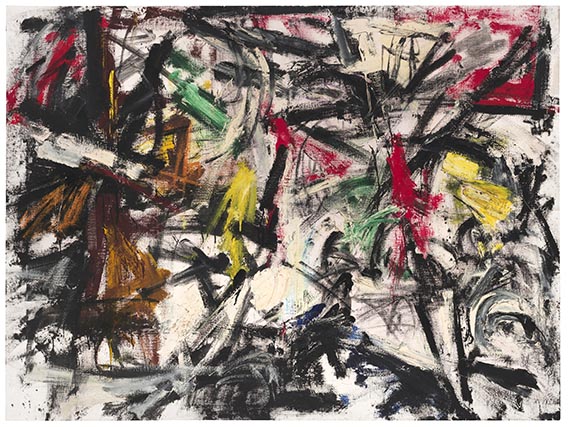
Tensione, N 4 V, 1959.
Acrilico
Stima:
€ 700,000 / $ 812,000 Risultato:
€ 967,500 / $ 1,122,300 ( commissione inclusa)
10
Emilio Vedova
Tensione, N 4 V, 1959.
Acrilico
Stima:
€ 700,000 / $ 812,000 Risultato:
€ 967,500 / $ 1,122,300 ( commissione inclusa)
Emilio Vedova
1919 - 2006
Tensione, N 4 V. 1959.
Acrylic.
Signed, dated, and titled on the reverse. 146 x 196 cm (57.4 x 77.1 in), in the artist's original frame. [JS].
• A monumental masterpiece from the heyday of international gestural painting.
• The year after the painting was created, Vedova received the Grand Prize for Painting at the 30th Venice Biennale.
• Participated in documenta I (1955), II (1959), and III (1964).
• A massive energy field: Transformation of Tintoretto’s rebellious painting into highly dynamic Action Painting.
• Galleria Blu: From the legendary Milanese avant-garde gallery that was already exhibiting Fontana, Burri, and Vedova by the late 1950s.
• Museum-quality: Paintings from this creative period are at, among others, the Museum of Modern Art, New York, and the Guggenheim Collection, New York/Venice.
• After 1960, Vedova's paintings began to fill the entire space, as in his spectacular work “Absurdes Beliner Tagebuch '64” (1964, Berlinische Galerie, Berlin).
PROVENANCE: Galleria Blu, Milan (1960, with the stamp on the stretcher).
Private collection, Europe (until 2017, Dorotheum).
Private collection, Northern Germany (since 2017, from the above).
EXHIBITION: Emilio Vedova, Galleria Blu, Milan, from February 29, 1960, cat. no. 9 (with illu., Immagine del tempo 1959, no. 5, V).
Premio Marzotto 1960, Mostra di pittura contemporanea della comunità Europea, Palazzo delle Permanente, Milan, October 22, 1960–January 20, 1960, p. 117, cat. no. 261 (with the label on the stretcher).
Prix Marzotto, Société auxiliaire des Expositions du Palais des Beaux-Arts, Brussels, January 1961, cat. no. 261 (with the label on the stretcher).
LITERATURE: Carlo L. Ragghianti, Critica d`arte, Vol. VI, No. 33, Florence 1959 (illustrated on the cover)
Dorotheum, Contemporary Art, Part I, May 31, 2017, Palais Dorotheum, Vienna, cat. no. 201 (illustrated).
"I must always get to the painting directly, maybe by jumping or sometimes with the help of a small stool [..] when I work, I move, I get physical, I jump and attack the canvas and the surrounding space."
Emilio Vedova, quoted from: Gallerie Thaddeus Ropac (https://ropac.net/de/artists/84-emilio-vedova-foundation/).
"On the other side of the Atlantic, these tendencies were grouped under the umbrella of American Abstract Expressionism, and in Japan under that of the Gutai group, While in Europe the definition European Informalism, or Art Informel, entered common parlance."
Roberto Pasini, The Informal. United States, Europ, Italy, Bologa 1995, p. 11.
"I would have identified my Matrix in tintoretto precisely because of that sense of upheavel and "metaphysical" dialogue consisting of leaps and liberations."
Emilio Vedova, hand-written notebook entry, undated, Fondazione Emilio e Annabianca Vedova, Venezia, PeS0059
1919 - 2006
Tensione, N 4 V. 1959.
Acrylic.
Signed, dated, and titled on the reverse. 146 x 196 cm (57.4 x 77.1 in), in the artist's original frame. [JS].
• A monumental masterpiece from the heyday of international gestural painting.
• The year after the painting was created, Vedova received the Grand Prize for Painting at the 30th Venice Biennale.
• Participated in documenta I (1955), II (1959), and III (1964).
• A massive energy field: Transformation of Tintoretto’s rebellious painting into highly dynamic Action Painting.
• Galleria Blu: From the legendary Milanese avant-garde gallery that was already exhibiting Fontana, Burri, and Vedova by the late 1950s.
• Museum-quality: Paintings from this creative period are at, among others, the Museum of Modern Art, New York, and the Guggenheim Collection, New York/Venice.
• After 1960, Vedova's paintings began to fill the entire space, as in his spectacular work “Absurdes Beliner Tagebuch '64” (1964, Berlinische Galerie, Berlin).
PROVENANCE: Galleria Blu, Milan (1960, with the stamp on the stretcher).
Private collection, Europe (until 2017, Dorotheum).
Private collection, Northern Germany (since 2017, from the above).
EXHIBITION: Emilio Vedova, Galleria Blu, Milan, from February 29, 1960, cat. no. 9 (with illu., Immagine del tempo 1959, no. 5, V).
Premio Marzotto 1960, Mostra di pittura contemporanea della comunità Europea, Palazzo delle Permanente, Milan, October 22, 1960–January 20, 1960, p. 117, cat. no. 261 (with the label on the stretcher).
Prix Marzotto, Société auxiliaire des Expositions du Palais des Beaux-Arts, Brussels, January 1961, cat. no. 261 (with the label on the stretcher).
LITERATURE: Carlo L. Ragghianti, Critica d`arte, Vol. VI, No. 33, Florence 1959 (illustrated on the cover)
Dorotheum, Contemporary Art, Part I, May 31, 2017, Palais Dorotheum, Vienna, cat. no. 201 (illustrated).
"I must always get to the painting directly, maybe by jumping or sometimes with the help of a small stool [..] when I work, I move, I get physical, I jump and attack the canvas and the surrounding space."
Emilio Vedova, quoted from: Gallerie Thaddeus Ropac (https://ropac.net/de/artists/84-emilio-vedova-foundation/).
"On the other side of the Atlantic, these tendencies were grouped under the umbrella of American Abstract Expressionism, and in Japan under that of the Gutai group, While in Europe the definition European Informalism, or Art Informel, entered common parlance."
Roberto Pasini, The Informal. United States, Europ, Italy, Bologa 1995, p. 11.
"I would have identified my Matrix in tintoretto precisely because of that sense of upheavel and "metaphysical" dialogue consisting of leaps and liberations."
Emilio Vedova, hand-written notebook entry, undated, Fondazione Emilio e Annabianca Vedova, Venezia, PeS0059
Informel/Abstract Expressionism/Gutai: Emilio Vedova and the Radical Emancipation of Gestural Painting
The artistic quest for the radical emancipation of energetic painterly gestures reached its peak not only in Europe but also in America and Japan in the late 1950s. In Europe, and particularly in France and Italy, an avant-garde emerged that declared the artistic gesture to be the sole protagonist of their seminal creations. Alongside the Venetian artist Emilio Vedova, Pierre Soulages was considered one of the most important representatives of Art Informel. Lucio Fontana’s famous canvas slashes, his “Concetti spaziali” or “Tagli”, created in Milan since the late 1950s and today mostly attributed to the European “ZERO” movement, are also to be seen in the context of this radical global movement focused on the artistic gesture, even if they were not executed with a brush. The avant-garde endeavours of these years marked a significant step in art history, one that radically transcended not only the long tradition of figurative painting but also, through large-scale works and the impulsive application of the paint, broke with the abstractionism prevalent in the first half of the century. In New York, for example, American Action Painting was at its peak, with artists such as Cy Twombly and Robert Motherwell paying homage to an artistic gesture liberated from all constraints, while in Tokyo, the Japanese artist Kazuo Shiraga created his works hanging from the ceiling and using his entire body to whip paint onto large canvases. Meanwhile, in Venice, Emilio Vedova, inspired by the great masters of Venetian painting, was developing his own radical, highly dynamic, and body-based approach to painting. In the 1950s, Vedova engaged with the painting of the Venetian Mannerist and artistic rebel Jacopo Tintoretto (1518/19–1594) in an almost ecstatic and obsessive manner. Tintoretto’s compositions, with their highly dynamic conception of space and a dramatic use of light, were both a source of fascination and a model for the young Venetian Vedova. Vedova was captivated by the swirling, almost chaotic energy of bodies and masses in space, as well as by the abolition of any static perspective—stylistic characteristics that were to have a decisive impact on his gestural all-over painting in large formats from that point on. Vedova was in his late thirties and at the peak of his creative output when he extracted and transformed the central principles from the work of Jacopo Tintoretto, the great 16th-century master in the late 1950s. These principles would henceforth serve as the central compositional principles for his abstract painting. “Just after the mid-point of the 1950s, Vedova had exhausted his forays into geometry, and turned his hand instead to an extraordinary recovery of action painting […].“ (Carlo Bertelli, Emilio Vedova, Milan 2006, p.?).
The present large-format composition “Tensione N 4 V” from 1959 is a particularly early and compelling testament to this powerful painting, which occupies a central position not only in Vedova’s oeuvre but also within the Abstraction of the second half of the 20th century. Due to its outstanding, almost ecstatic dynamism, “Tensione N 4 V” embodies the full force of its highly energetic creative process and, moreover, serves as a visual testament to this highly significant chapter in art history.
Vedova’s “Tensione N 4 V” (1959) and Tintoretto’s “Il Paradiso” (1588/94): A Radical Transformation in Painting
Born in the lagoon city of Venice in 1919, Vedova was fascinated with the paintings of the noted Venetian Mannerist Jacoppo Tintoretto, and, above all, with his monumental painting “Il Paradiso” on display in the Sala del Maggior Consiglio of the Doge’s Palace. Measuring an enormous 9 meters in height and more than 22 meters in width, Tintoretto’s “Il Paradiso” is still considered one of the largest canvas paintings in the world today. Its complex, floor-to-ceiling composition has captivated generations of painters. By the end of the 16th century, Tintoretto had already spread nearly 500 figures across the canvas in a dynamic swirl that was entirely novel at the time. He had transcended traditional principles of perspective, with a composition dominated by a central divine light. Vedova was fascinated with “Il Paradiso” for its highly dynamic “scene of events” (sede di accadimenti), the whirlwind of energy and bodies that occupy the pictorial space, and the metaphysical energy emanating from this immense canvas. For Vedova, Tintoretto was a kindred spirit; his rapid, dynamic brushstrokes and his physical approach to painting were a major inspiration, making “Il Paradiso” ultimately a kind of painterly precursor to all artistic principles that would be of vital significance for avant-garde abstraction of the 1950s: “Tintoretto was my identification. This space is precisely a place of action. This direction, with its syncopated and bloody rhythms, magmatic with energies from the inner reservoir of passions…” (Emilio Vedova)
Vedova’s painting was similarly characterized by speed, Impulsiveness, drama, and physical exertion. In “Tensione N 4 V,” however, the artist did not merely capture the enormous physical force of its creation on the canvas, but also translated the rhythm of the composition and the Baroque drama of light and shadow from Tintoretto’s monumental Resurrection scene in “Il Paradiso” into the radically emancipated gestures of Art Informel. Vedova understood Tintoretto’s “Il Paradiso” primarily as a highly dynamic force field, which explains why he repeatedly used terms such as “Scontro” (clash) and “Tensione” (tension) to describe the special dynamics in Tintoretto’s composition in his diary entries. Vedova later adopted both terms as titles for his own works, as in the present early canvas “Tensione N 4 V.” Since the late 1950s, his abstract formal language has been decisively dynamized by this process of transformation and by Vedova’s physical action painting technique, which involves jumping and literally attacking the canvas with paint. The nature of “Tensione N 4 V” is exceptionally spontaneous and vibrant, and—though highly abstract—it still embodies the central elements of form, movement, and light found in Tintoretto’s “Il Paradiso.”
Tensione N 4 V”: From the legendary Galleria Blu to a major Northern German private collection
First presented at the legendary Galleria Blu in Milan as part of the first Vedova exhibition in 1960, “Tensione N 4 V” ranks among the most compelling works by the nonconformist Venetian rebel. Inspired by Jacopo Tintoretto in the 1950s, Vedova began painting with his entire body. Established by Peppino Palazzoli in 1957, the avant-garde gallery had been exhibiting works by Lucio Fontana, Alberto Burri, and Emilio Vedova since the late 1950s, making a significant contribution to the international recognition of the Italian avant-garde emerging at that time. Vedova’s exceptionally rare, large-format canvases from this significant early creative phase are captivating testimonies to an impulsive painting style that, in a truly unsettling way, still conveys the raw power and vitality of their unique creation process. It is therefore neither surprising that paintings of comparable quality are held in important international collections today, nor is it unusual that the early composition “Tensione N 4 V” fetched the highest international price for an Emilio Vedova painting as early as 2017. At that time, it was sold from a European private collection to an important Northern German private collection of international postwar art and was—albeit only for a short time—on public view for the first time in nearly sixty years. [JS]
The artistic quest for the radical emancipation of energetic painterly gestures reached its peak not only in Europe but also in America and Japan in the late 1950s. In Europe, and particularly in France and Italy, an avant-garde emerged that declared the artistic gesture to be the sole protagonist of their seminal creations. Alongside the Venetian artist Emilio Vedova, Pierre Soulages was considered one of the most important representatives of Art Informel. Lucio Fontana’s famous canvas slashes, his “Concetti spaziali” or “Tagli”, created in Milan since the late 1950s and today mostly attributed to the European “ZERO” movement, are also to be seen in the context of this radical global movement focused on the artistic gesture, even if they were not executed with a brush. The avant-garde endeavours of these years marked a significant step in art history, one that radically transcended not only the long tradition of figurative painting but also, through large-scale works and the impulsive application of the paint, broke with the abstractionism prevalent in the first half of the century. In New York, for example, American Action Painting was at its peak, with artists such as Cy Twombly and Robert Motherwell paying homage to an artistic gesture liberated from all constraints, while in Tokyo, the Japanese artist Kazuo Shiraga created his works hanging from the ceiling and using his entire body to whip paint onto large canvases. Meanwhile, in Venice, Emilio Vedova, inspired by the great masters of Venetian painting, was developing his own radical, highly dynamic, and body-based approach to painting. In the 1950s, Vedova engaged with the painting of the Venetian Mannerist and artistic rebel Jacopo Tintoretto (1518/19–1594) in an almost ecstatic and obsessive manner. Tintoretto’s compositions, with their highly dynamic conception of space and a dramatic use of light, were both a source of fascination and a model for the young Venetian Vedova. Vedova was captivated by the swirling, almost chaotic energy of bodies and masses in space, as well as by the abolition of any static perspective—stylistic characteristics that were to have a decisive impact on his gestural all-over painting in large formats from that point on. Vedova was in his late thirties and at the peak of his creative output when he extracted and transformed the central principles from the work of Jacopo Tintoretto, the great 16th-century master in the late 1950s. These principles would henceforth serve as the central compositional principles for his abstract painting. “Just after the mid-point of the 1950s, Vedova had exhausted his forays into geometry, and turned his hand instead to an extraordinary recovery of action painting […].“ (Carlo Bertelli, Emilio Vedova, Milan 2006, p.?).
The present large-format composition “Tensione N 4 V” from 1959 is a particularly early and compelling testament to this powerful painting, which occupies a central position not only in Vedova’s oeuvre but also within the Abstraction of the second half of the 20th century. Due to its outstanding, almost ecstatic dynamism, “Tensione N 4 V” embodies the full force of its highly energetic creative process and, moreover, serves as a visual testament to this highly significant chapter in art history.
Vedova’s “Tensione N 4 V” (1959) and Tintoretto’s “Il Paradiso” (1588/94): A Radical Transformation in Painting
Born in the lagoon city of Venice in 1919, Vedova was fascinated with the paintings of the noted Venetian Mannerist Jacoppo Tintoretto, and, above all, with his monumental painting “Il Paradiso” on display in the Sala del Maggior Consiglio of the Doge’s Palace. Measuring an enormous 9 meters in height and more than 22 meters in width, Tintoretto’s “Il Paradiso” is still considered one of the largest canvas paintings in the world today. Its complex, floor-to-ceiling composition has captivated generations of painters. By the end of the 16th century, Tintoretto had already spread nearly 500 figures across the canvas in a dynamic swirl that was entirely novel at the time. He had transcended traditional principles of perspective, with a composition dominated by a central divine light. Vedova was fascinated with “Il Paradiso” for its highly dynamic “scene of events” (sede di accadimenti), the whirlwind of energy and bodies that occupy the pictorial space, and the metaphysical energy emanating from this immense canvas. For Vedova, Tintoretto was a kindred spirit; his rapid, dynamic brushstrokes and his physical approach to painting were a major inspiration, making “Il Paradiso” ultimately a kind of painterly precursor to all artistic principles that would be of vital significance for avant-garde abstraction of the 1950s: “Tintoretto was my identification. This space is precisely a place of action. This direction, with its syncopated and bloody rhythms, magmatic with energies from the inner reservoir of passions…” (Emilio Vedova)
Vedova’s painting was similarly characterized by speed, Impulsiveness, drama, and physical exertion. In “Tensione N 4 V,” however, the artist did not merely capture the enormous physical force of its creation on the canvas, but also translated the rhythm of the composition and the Baroque drama of light and shadow from Tintoretto’s monumental Resurrection scene in “Il Paradiso” into the radically emancipated gestures of Art Informel. Vedova understood Tintoretto’s “Il Paradiso” primarily as a highly dynamic force field, which explains why he repeatedly used terms such as “Scontro” (clash) and “Tensione” (tension) to describe the special dynamics in Tintoretto’s composition in his diary entries. Vedova later adopted both terms as titles for his own works, as in the present early canvas “Tensione N 4 V.” Since the late 1950s, his abstract formal language has been decisively dynamized by this process of transformation and by Vedova’s physical action painting technique, which involves jumping and literally attacking the canvas with paint. The nature of “Tensione N 4 V” is exceptionally spontaneous and vibrant, and—though highly abstract—it still embodies the central elements of form, movement, and light found in Tintoretto’s “Il Paradiso.”
Tensione N 4 V”: From the legendary Galleria Blu to a major Northern German private collection
First presented at the legendary Galleria Blu in Milan as part of the first Vedova exhibition in 1960, “Tensione N 4 V” ranks among the most compelling works by the nonconformist Venetian rebel. Inspired by Jacopo Tintoretto in the 1950s, Vedova began painting with his entire body. Established by Peppino Palazzoli in 1957, the avant-garde gallery had been exhibiting works by Lucio Fontana, Alberto Burri, and Emilio Vedova since the late 1950s, making a significant contribution to the international recognition of the Italian avant-garde emerging at that time. Vedova’s exceptionally rare, large-format canvases from this significant early creative phase are captivating testimonies to an impulsive painting style that, in a truly unsettling way, still conveys the raw power and vitality of their unique creation process. It is therefore neither surprising that paintings of comparable quality are held in important international collections today, nor is it unusual that the early composition “Tensione N 4 V” fetched the highest international price for an Emilio Vedova painting as early as 2017. At that time, it was sold from a European private collection to an important Northern German private collection of international postwar art and was—albeit only for a short time—on public view for the first time in nearly sixty years. [JS]