


 Lot 114
Cornice
114
Otto Mueller
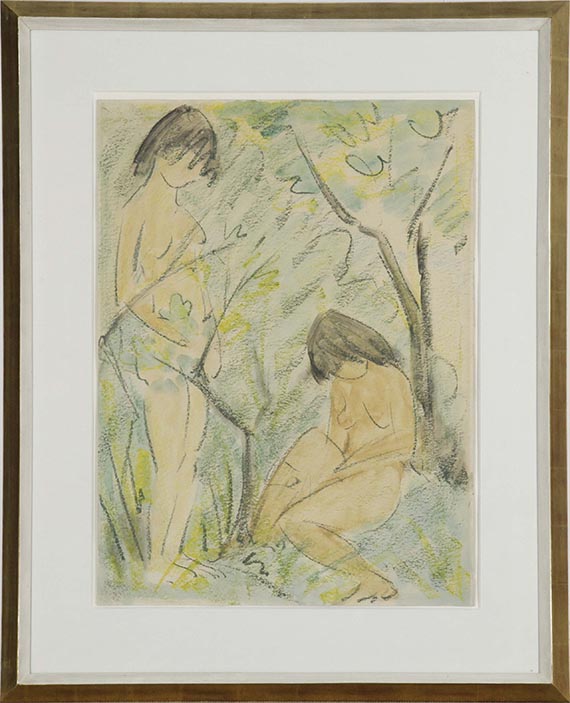
Zwei Mädchenakte, einer sitzend, Um 1925.
Watercolor and color chalks
Stima: € 80,000 / $ 92,800
Otto Mueller
1874 - 1930
Zwei Mädchenakte, einer sitzend. Um 1925.
Watercolor and color chalks.
On wove paper. 67.4 x 50 cm (26.5 x 19.6 in), the full sheet. [CH].
• Large elaborate drawing from the sought-after 1920s.
• In a subtly nuanced yet powerful palette, the artist visualizes his lifelong pursuit of a harmonious unity between man and nature.
• The epitome of Otto Mueller's characteristic graphic style and stylized formal language.
• The depiction of female nudes in the great outdoors is considered a central motif in his oeuvre.
• Comparable works from the 1920s are part of important museum collections, including the Kupferstichkabinett of the Staatliche Museen zu Berlin, the Albertina in Vienna, and the Detroit Institute of Arts.
PROVENANCE: Emmy Mueller, Berlin (the artist's sister, with a handwritten ownership note on the reverse).
Galerie Thomas, Munich.
Private collection, southern Germany (probably acquired in the 1980s).
Since then in family ownership.
LITERATURE: Tanja Pirsig-Marshall and Mario-Andreas von Lüttichau, Otto Mueller. Catalogue raisonné, volume II (Drawings and Watercolors), Leipzig 2020, CR no. 1925/01 (with color illustration, p. 161).
Tanja Pirsig-Marshall and Mario-Andreas von Lüttichau, Otto Mueller. Catalogue raisonné of paintings and drawings (CD-ROM), Munich 2003, Essen 2007/2008, CR no. 290.
"The main goal of my endeavors is to express my perception of landscape and nature with the greatest possible simplicity [..]."
Otto Mueller, in: exhib. cat. Otto Mueller, Kunstsalon Paul Cassirer, Berlin, April/May 1919.
Called up: December 6, 2025 - ca. 13.18 h +/- 20 min.
1874 - 1930
Zwei Mädchenakte, einer sitzend. Um 1925.
Watercolor and color chalks.
On wove paper. 67.4 x 50 cm (26.5 x 19.6 in), the full sheet. [CH].
• Large elaborate drawing from the sought-after 1920s.
• In a subtly nuanced yet powerful palette, the artist visualizes his lifelong pursuit of a harmonious unity between man and nature.
• The epitome of Otto Mueller's characteristic graphic style and stylized formal language.
• The depiction of female nudes in the great outdoors is considered a central motif in his oeuvre.
• Comparable works from the 1920s are part of important museum collections, including the Kupferstichkabinett of the Staatliche Museen zu Berlin, the Albertina in Vienna, and the Detroit Institute of Arts.
PROVENANCE: Emmy Mueller, Berlin (the artist's sister, with a handwritten ownership note on the reverse).
Galerie Thomas, Munich.
Private collection, southern Germany (probably acquired in the 1980s).
Since then in family ownership.
LITERATURE: Tanja Pirsig-Marshall and Mario-Andreas von Lüttichau, Otto Mueller. Catalogue raisonné, volume II (Drawings and Watercolors), Leipzig 2020, CR no. 1925/01 (with color illustration, p. 161).
Tanja Pirsig-Marshall and Mario-Andreas von Lüttichau, Otto Mueller. Catalogue raisonné of paintings and drawings (CD-ROM), Munich 2003, Essen 2007/2008, CR no. 290.
"The main goal of my endeavors is to express my perception of landscape and nature with the greatest possible simplicity [..]."
Otto Mueller, in: exhib. cat. Otto Mueller, Kunstsalon Paul Cassirer, Berlin, April/May 1919.
Called up: December 6, 2025 - ca. 13.18 h +/- 20 min.
The female nude, and in particular the motif of the female nude in the landscape —a motif with a long tradition in art history —dominates Otto Mueller's entire artistic oeuvre. Like his fellow painters from the “Brücke” artists' group, of which he was a member from 1910 until its disbandment in 1913, Otto Mueller sought the greatest possible naturalness and a harmonious unity between man and nature, both in his artistic work and in his personal life.
For this purpose, Mueller places his de-individualized figures in a seemingly untouched, paradisiacal natural environment that shows no signs of modern civilization. They are far removed from the big city and technology, untouched by the rapid social transformation and industrialization of the time, and without any temporal reference. Unlike Kirchner or Heckel, Otto Mueller did not depict expressive and spontaneously captured scenes from everyday life, but rather carefully staged, balanced compositions. Dreamy and almost statuesque, his protagonists are idealized, reduced forms surrounded by vast landscapes or dense vegetation, ponds, and groups of trees. They blend into their surroundings as if it were the most natural thing in the world, forming a harmonious whole without any sense of irritation.
With refined graphic finesse, a few confident strokes, and delicate yet effective contrasts, Otto Mueller captures his figures on paper, covering the entire page, in a clear, atmospheric interplay of watercolor and painterly chalk. The nude on the left is not only surrounded by nature, but virtually encased by foliage and branches.
Mueller does not present individual female figures but rather a universal expression of femininity and humanity, of primal nature and an otherworldly mood, in a stylization reminiscent of Oskar Schlemmer's male figures or even Alexej von Jawlensky's abstract heads. The portrayal of double figures occupies a unique position within this range of motifs: like the individual nudes, they are withdrawn, with no contact between them, avoiding any interaction and entirely self-absorbed. As a result, Mueller unfolds a compelling tension between his figures, a tension palpable in the present, exceptionally balanced composition. [CH]
For this purpose, Mueller places his de-individualized figures in a seemingly untouched, paradisiacal natural environment that shows no signs of modern civilization. They are far removed from the big city and technology, untouched by the rapid social transformation and industrialization of the time, and without any temporal reference. Unlike Kirchner or Heckel, Otto Mueller did not depict expressive and spontaneously captured scenes from everyday life, but rather carefully staged, balanced compositions. Dreamy and almost statuesque, his protagonists are idealized, reduced forms surrounded by vast landscapes or dense vegetation, ponds, and groups of trees. They blend into their surroundings as if it were the most natural thing in the world, forming a harmonious whole without any sense of irritation.
With refined graphic finesse, a few confident strokes, and delicate yet effective contrasts, Otto Mueller captures his figures on paper, covering the entire page, in a clear, atmospheric interplay of watercolor and painterly chalk. The nude on the left is not only surrounded by nature, but virtually encased by foliage and branches.
Mueller does not present individual female figures but rather a universal expression of femininity and humanity, of primal nature and an otherworldly mood, in a stylization reminiscent of Oskar Schlemmer's male figures or even Alexej von Jawlensky's abstract heads. The portrayal of double figures occupies a unique position within this range of motifs: like the individual nudes, they are withdrawn, with no contact between them, avoiding any interaction and entirely self-absorbed. As a result, Mueller unfolds a compelling tension between his figures, a tension palpable in the present, exceptionally balanced composition. [CH]
114
Otto Mueller
Zwei Mädchenakte, einer sitzend, Um 1925.
Watercolor and color chalks
Stima: € 80,000 / $ 92,800
Commissione, tassa e diritti di seguito
Quest'oggetto viene offerto con regime fiscale normale o con imposizione sul margine di profitto.
Calcolo commissione particolare sul margine del profitto:
- Prezzo d’aggiudicazione fino a 1.000.000 euro: provvigione del 34%.
- Per la parte del prezzo d’aggiudicazione superiore a 1.000.000 euro si calcola una provvigione del 29%, che viene aggiunta a quella relativa alla parte del prezzo d’aggiudicazione fino a 1.000.000 euro.
- Per la parte del prezzo d’aggiudicazione superiore a 4.000.000 euro si calcola una provvigione del 22%, che viene aggiunta a quella relativa alla parte del prezzo d’aggiudicazione fino a 4.000.000 euro.
La provvigione comprende l'IVA, ma questa non viene indicata.
Calcolo regime fiscale normale:
Prezzo di aggiudicazione fino a 1.000.000 €: supplemento del 29%.
Prezzo di aggiudicazione superiore a 1.000.000 €: Parte del prezzo fino a 1.000.000 € supplemento del 29 %, parte del prezzo che supera i 1.000.000 € supplemento del 23%.
Prezzo di aggiudicazione superiore a 4.000.000 €: Parte del prezzo che supera i 4.000.000 € supplemento del 15%.
L'IVA prevista dalla legge è pari al 7 % sulla somma del prezzo di aggiudicazione e del supplemento.
La preghiamo di avvisarci prima della fatturazione nel caso in cui desidera applicare il regime fiscale normale.
Calcolo diritti di seguito:
Per le opere originali di arti figurative e fotografie di artisti viventi o deceduti da meno di 70 anni soggette al diritto di seguito, in tutti i casi suddetti viene riscossa in aggiunta, a liquidazione della compensazione del diritto di seguito dovuto dalla casa d'aste ai sensi del § 26 della legge tedesca sul diritto d'autore (Urheberrechtsgesetz, UrhG), una compensazione del diritto di seguito con le percentuali indicate nel § 26 2° comma UrhG, che attualmente sono le seguenti:
4 per cento della parte del ricavo della vendita da 400,00 euro a 50.000 euro,
un altro 3 per cento della parte del ricavo della vendita da 50.000,01 a 200.000 Euro,
un altro 1 per cento della parte del ricavo della vendita da 200.000,01 a 350.000 Euro,
un altro 0,5 per cento della parte del ricavo della vendita da 350.000,01 a 500.000 euro e
un altro 0,25 per cento della parte del ricavo della vendita superiore a 500.000 euro.
L’importo complessivo della compensazione del diritto di seguito derivante da una rivendita è pari al massimo a 12.500 euro.
Calcolo commissione particolare sul margine del profitto:
- Prezzo d’aggiudicazione fino a 1.000.000 euro: provvigione del 34%.
- Per la parte del prezzo d’aggiudicazione superiore a 1.000.000 euro si calcola una provvigione del 29%, che viene aggiunta a quella relativa alla parte del prezzo d’aggiudicazione fino a 1.000.000 euro.
- Per la parte del prezzo d’aggiudicazione superiore a 4.000.000 euro si calcola una provvigione del 22%, che viene aggiunta a quella relativa alla parte del prezzo d’aggiudicazione fino a 4.000.000 euro.
La provvigione comprende l'IVA, ma questa non viene indicata.
Calcolo regime fiscale normale:
Prezzo di aggiudicazione fino a 1.000.000 €: supplemento del 29%.
Prezzo di aggiudicazione superiore a 1.000.000 €: Parte del prezzo fino a 1.000.000 € supplemento del 29 %, parte del prezzo che supera i 1.000.000 € supplemento del 23%.
Prezzo di aggiudicazione superiore a 4.000.000 €: Parte del prezzo che supera i 4.000.000 € supplemento del 15%.
L'IVA prevista dalla legge è pari al 7 % sulla somma del prezzo di aggiudicazione e del supplemento.
La preghiamo di avvisarci prima della fatturazione nel caso in cui desidera applicare il regime fiscale normale.
Calcolo diritti di seguito:
Per le opere originali di arti figurative e fotografie di artisti viventi o deceduti da meno di 70 anni soggette al diritto di seguito, in tutti i casi suddetti viene riscossa in aggiunta, a liquidazione della compensazione del diritto di seguito dovuto dalla casa d'aste ai sensi del § 26 della legge tedesca sul diritto d'autore (Urheberrechtsgesetz, UrhG), una compensazione del diritto di seguito con le percentuali indicate nel § 26 2° comma UrhG, che attualmente sono le seguenti:
4 per cento della parte del ricavo della vendita da 400,00 euro a 50.000 euro,
un altro 3 per cento della parte del ricavo della vendita da 50.000,01 a 200.000 Euro,
un altro 1 per cento della parte del ricavo della vendita da 200.000,01 a 350.000 Euro,
un altro 0,5 per cento della parte del ricavo della vendita da 350.000,01 a 500.000 euro e
un altro 0,25 per cento della parte del ricavo della vendita superiore a 500.000 euro.
L’importo complessivo della compensazione del diritto di seguito derivante da una rivendita è pari al massimo a 12.500 euro.