


21
Daniel Richter
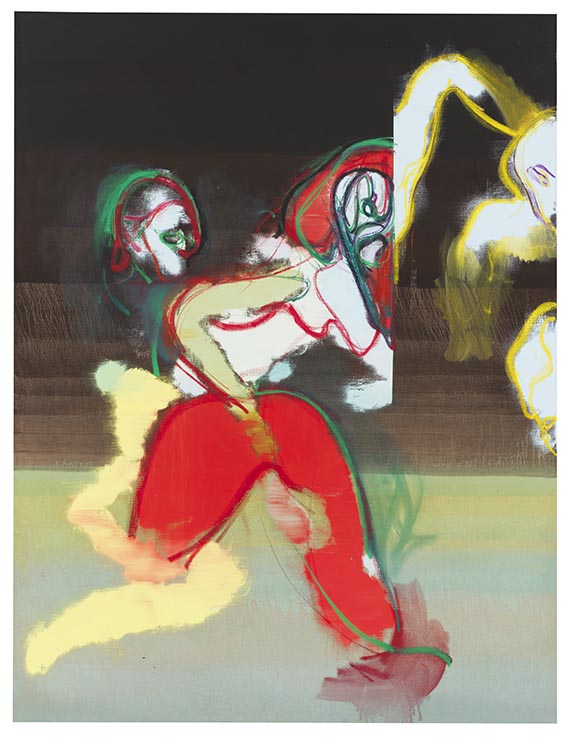
Gestern, von hinten, 2016.
Olio su tela
Stima: € 140,000 / $ 156,800
Daniel Richter
1962
Gestern, von hinten. 2016.
Oil on canvas.
Signed, dated, and titled on the reverse of the canvas. 210 x 160 cm (82.6 x 62.9 in). [AW].
• SUPERSTAR Daniel Richter – One of the most influential painters of the contemporary art scene.
• PROVOCATIVE A painting straddling the line between abstraction and figuration.
• EPHEMERAL Expressive color and shadowy figures oscillate on a monumental canvas.
• RETROSPECTIVE In the year of its creation, the Louisiana Museum of Modern Art in Humlebæk presented “Daniel Richter – Lonely Old Slogans.”
• MUSEUM QUALITY Richter’s works are at, among others, the Kunsthalle Hamburg, the Städel Museum in Frankfurt am Main, the Centre Pompidou in Paris, and the Museum of Modern Art in New York.
PROVENANCE: Galerie Thaddaeus Ropac, Salzburg (with a gallery label on the reverse of the stretcher).
Private collection, Bavaria (acquired from the above in 2016).
Called up: December 4, 2026 - ca. 17.40 h +/- 20 min.
Daniel Richter’s “Gestern, von hinten” (Yesterday, from Behind) from 2016 epitomizes his distinct style: vibrant colors and dynamic lines that envelop his figures in an intense interplay of abstraction and figuration. A wild tangle of limbs intertwines with bold physical forms and elongated streaks of color that stretch across the canvas like electrical impulses, oscillating in a minimalist “non-space” between reality and the dissolution of form. The color red, which catches the eye right away in our work, signals associations with blood, passion, and even political symbols. Richter imbues this work with a provocative, almost inescapable presence. He plays with layers of meaning and leaves the interpretation of possible ambiguities to the viewer. The fragmented figures appear to be captured in a frozen moment as they perform their dance. The figure in the right margin of the painting seems to be gazing at a scene that is hidden from our view. In this manner, the figures oscillate between closeness and distance, fascination and confusion.
The work was created in 2016, at a turning point in Richter’s career. The 2015 retrospective at the Schirn Kunsthalle in Frankfurt was followed by a monographic exhibition at the Louisiana Museum of Modern Art in Humlebæk in 2016, both of which attest to his growing international significance. Richter, born in Eutin in 1962 and a professor at the Vienna Academy of Fine Arts since 2006, turned away from the political works of the 1990s during this period and moved toward an introspective yet critical examination of contemporary subjectivity. His most recent works oscillate between figuration and abstraction: fragmented bodies intertwine to form chaotic compositions against backgrounds of reduced color, of which this work is a particularly striking example. Drawing inspiration from Symbolists such as James Ensor and Edvard Munch, Richter combines motifs from art history, mass media, and pop culture to create idiosyncratic, surreal visual worlds. His work also extends beyond the visual arts: in the 1990s, he made a name for himself in music, designing album covers and posters; since 2005, he has run his own record label.
This body of work is a monumental expression of Daniel Richter’s artistic development. It demonstrates his ability to unite social taboos, political and art-historical symbolism, and human intimacy into a single, overwhelming image. As a result, Daniel Richter remains, without a doubt, one of the most sought-after artists in contemporary painting. [AW]


Commissione, tassa e diritti di seguito
Quest'oggetto viene offerto con regime fiscale normale o con imposizione sul margine di profitto.
Calcolo commissione particolare sul margine del profitto:
- Prezzo d’aggiudicazione fino a 2.000.000 euro: provvigione del 34%.
- Per la parte del prezzo d’aggiudicazione superiore a 2.000.000 euro si calcola una provvigione del 29%, che viene aggiunta a quella relativa alla parte del prezzo d’aggiudicazione fino a 2.000.000 euro.
- Per la parte del prezzo d’aggiudicazione superiore a 4.000.000 euro si calcola una provvigione del 22%, che viene aggiunta a quella relativa alla parte del prezzo d’aggiudicazione fino a 4.000.000 euro.
La provvigione comprende l'IVA, ma questa non viene indicata.
Calcolo regime fiscale normale:
Prezzo di aggiudicazione fino a 2.000.000 €: supplemento del 29%.
Prezzo di aggiudicazione superiore a 2.000.000 €: Parte del prezzo fino a 2.000.000 € supplemento del 29 %, parte del prezzo che supera i 2.000.000 € supplemento del 23%.
Prezzo di aggiudicazione superiore a 4.000.000 €: Parte del prezzo che supera i 4.000.000 € supplemento del 15%.
L'IVA prevista dalla legge è pari al 7 % sulla somma del prezzo di aggiudicazione e del supplemento.
La preghiamo di avvisarci prima della fatturazione nel caso in cui desidera applicare il regime fiscale normale.
Calcolo diritti di seguito:
Per le opere originali di arti figurative e fotografie di artisti viventi o deceduti da meno di 70 anni soggette al diritto di seguito, in tutti i casi suddetti viene riscossa in aggiunta, a liquidazione della compensazione del diritto di seguito dovuto dalla casa d'aste ai sensi del § 26 della legge tedesca sul diritto d'autore (Urheberrechtsgesetz, UrhG), una compensazione del diritto di seguito con le percentuali indicate nel § 26 2° comma UrhG, che attualmente sono le seguenti:
4 per cento della parte del ricavo della vendita da 400,00 euro a 50.000 euro,
un altro 3 per cento della parte del ricavo della vendita da 50.000,01 a 200.000 Euro,
un altro 1 per cento della parte del ricavo della vendita da 200.000,01 a 350.000 Euro,
un altro 0,5 per cento della parte del ricavo della vendita da 350.000,01 a 500.000 euro e
un altro 0,25 per cento della parte del ricavo della vendita superiore a 500.000 euro.
L’importo complessivo della compensazione del diritto di seguito derivante da una rivendita è pari al massimo a 12.500 euro.