


14
Ernst Wilhelm Nay
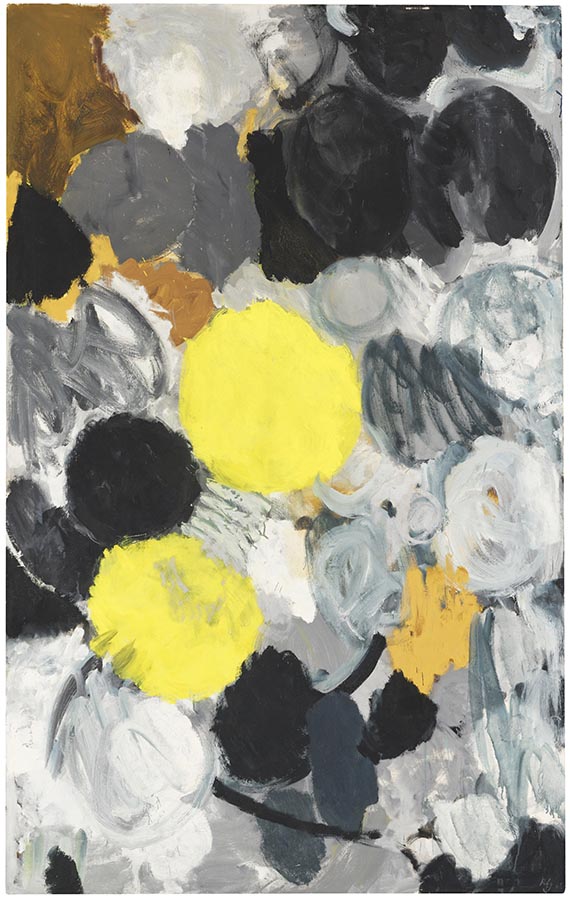
Gelb und Silbergrau, 1961.
Olio su tela
Stima: € 200,000 / $ 224,000
14
Ernst Wilhelm Nay
Gelb und Silbergrau, 1961.
Olio su tela
Stima: € 200,000 / $ 224,000
Ernst Wilhelm Nay
1902 - 1968
Gelb und Silbergrau. 1961.
Oil on canvas.
Signed and dated in the lower right. Signed, dated, titled, and inscribed with a direction arrow on the reverse of the stretcher. 200 x 125 cm (78.7 x 49.2 in).
[AR].
• ULTIMATE EXPRESSIVENESS The pure abstraction of Nay’s disk in an impressive large format.
• CONTRAST A striking juxtaposition of light and dark, yellow and silver-gray.
• TRANSATLANTIC Exhibited in Pittsburgh alongside works by Albers, Motherwell, and Rothko as early as 1961.
• MUSEUM QUALITY Comparable vertical-format works are at the Museum Ludwig in Cologne, the Städel Museum in Frankfurt am Main, and the Guggenheim Museum in New York.
PROVENANCE: M. Knoedler & Co., Inc., New York.
John Day and Carroll Stuchell, Pittsburgh (acquired from the above in 1967, with label).
M. Knoedler & Co., Inc., New York.
Private collection, Zurich.
Private collection (since 1994; Sotheby’s London, Nov. 30, 1994, lot 15).
From a German collection.
EXHIBITION: The 1961 Pittsburgh International Exhibition of Contemporary Painting and Sculpture, Carnegie Institute of Art, Pittsburgh, Oct. 27, 1961–Jan. 7, 1962, cat. no. 284 (with label).
LITERATURE: Aurel Scheibler, Ernst Wilhelm Nay. Catalogue raisonné of oil paintings, Vol. 2: 1952–1968, Cologne 1990, p. 225, CR no. 995 (with color illustration on p. 212).
- -
Fritz Usinger, Ernst Wilhelm Nay, Recklinghausen 1961, p. 25 (illustrated on p. 56).
The 42nd Pittsburgh International, in: Art International, vol. V, no. 8, Oct. 20, 1961 (illustrated on p. 73).
“Anyone viewing Nay’s paintings feels stirred and moved by the power of an immediate, inherently dynamic appearance [.]”
Quote from the prominent German art historian Max Imdahl, in: ibid., Ernst Wilhelm Nay, Stuttgart 1962, p. 5.
Called up: December 4, 2026 - ca. 17.26 h +/- 20 min.
“Anyone who views Nay’s paintings feels stirred and moved by the power of an immediate appearance that is dynamic in and of itself [...]” These are the words the renowned art historian and early proponent of modern art criticism Max Imdahl once used to describe the impact of Ernst Wilhelm Nay’s paintings (Max Imdahl, Ernst Wilhelm Nay, Stuttgart 1962, p. 5). What ultimately unfolds before the viewer’s eyes as an apparition results from an extraordinary artistic achievement and a nuanced interplay of color, form, and painting technique. This present work, “Gelb und Silbergrau” (Yellow and Silver-Gray) from 1961, conveys this experience with particular intensity.
The dense juxtaposition and superimposition of the disc-like forms that are so characteristic of Nay, the famous pinnacle of his abstraction, result in this impressive portrait format, where dark shades of gray and black intersect with a few bright yellow accents. The pronounced, almost dramatic chiaroscuro contrast lends the freely composed pictorial space a dynamic order in which the seemingly weightless circular forms appear to float between surface and space.
Nay thus combines color and form to create a liberated and extraordinarily vibrant interplay of shifting forces, which Max Imdahl so aptly describes as “a choreography of color harmony, space, and surface” (Max Imdahl, op. cit., p. 16).
In the very year it was created, “Gelb und Silbergrau” featured in a major retrospective exhibition in Pittsburgh alongside works by Josef Albers, Robert Motherwell, and Mark Rothko. Only a year later, the New York gallery Knoedler dedicated a solo exhibition to the German artist; a few years later, the painting eventually found its way into a private collection in Pittsburgh through the gallery. “Gelb und Silbergrau” is representative of the emerging international appreciation for Nay’s now-famous “Disc Paintings" which continue to make a powerful impression with their distinctive, effective visual language and timeless dramatic composition. [AR]


Commissione, tassa e diritti di seguito
Quest'oggetto viene offerto con regime fiscale normale.
Calcolo regime fiscale normale:
Prezzo di aggiudicazione fino a 2.000.000 €: supplemento del 29%. Prezzo di aggiudicazione superiore a 2.000.000 €: Parte del prezzo fino a 2.000.000 € supplemento del 29 %, parte del prezzo che supera i 2.000.000 € supplemento del 23%.
Prezzo di aggiudicazione superiore a 4.000.000 €: Parte del prezzo che supera i 4.000.000 € supplemento del 15%.
L'IVA prevista dalla legge è pari al 7 % sulla somma del prezzo di aggiudicazione e del supplemento.
Calcolo diritti di seguito:
Per le opere originali di arti figurative e fotografie di artisti viventi o deceduti da meno di 70 anni soggette al diritto di seguito, in tutti i casi suddetti viene riscossa in aggiunta, a liquidazione della compensazione del diritto di seguito dovuto dalla casa d'aste ai sensi del § 26 della legge tedesca sul diritto d'autore (Urheberrechtsgesetz, UrhG), una compensazione del diritto di seguito con le percentuali indicate nel § 26 2° comma UrhG, che attualmente sono le seguenti:
4 per cento della parte del ricavo della vendita da 400,00 euro a 50.000 euro,
un altro 3 per cento della parte del ricavo della vendita da 50.000,01 a 200.000 Euro,
un altro 1 per cento della parte del ricavo della vendita da 200.000,01 a 350.000 Euro,
un altro 0,5 per cento della parte del ricavo della vendita da 350.000,01 a 500.000 euro e
un altro 0,25 per cento della parte del ricavo della vendita superiore a 500.000 euro.
L’importo complessivo della compensazione del diritto di seguito derivante da una rivendita è pari al massimo a 12.500 euro.