


Asta: 611 / Day Sale del 05 dicembre 2026 a Monaco di Baviera → Lot 125000820
Cornice
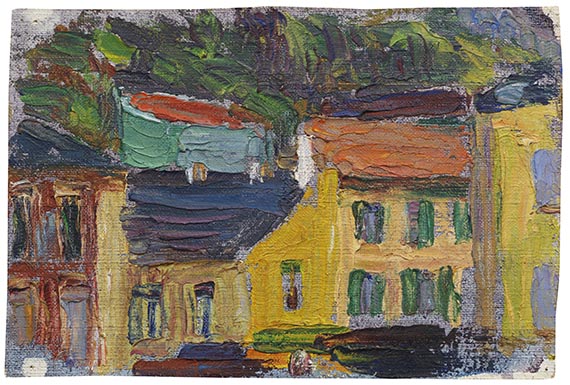
125000820
Wassily Kandinsky
Häuser (Sestri Levante/Rapallo), 1905/06.
Olio su tela
Stima: € 90,000 / $ 104,400
Le informationi sulla commissione, le tasse e il diritto di seguito saranno disponibili quattro settimane prima dell´asta.
125000820
Wassily Kandinsky
Häuser (Sestri Levante/Rapallo), 1905/06.
Olio su tela
Stima: € 90,000 / $ 104,400
Le informationi sulla commissione, le tasse e il diritto di seguito saranno disponibili quattro settimane prima dell´asta.
Wassily Kandinsky
1866 - 1944
Häuser (Sestri Levante/Rapallo). 1905/06.
Oil on canvas.
16,2 24.4 cm (9.6 in).
• Offered on the international auction market for the first time.
• Originally from the collection of Gabriele Münter.
• Small canvas bursting with vibrant color.
Accompanied by a letter from the Société Kandinsky dated March 18, 1987 (copy).
PROVENANCE: Gabriele Münter, Murnau.
Grcic-Ziersch Art Dealership, Munich.
Private collection, North Rhine-Westphalia (1994, from the above)
Private collection, Bavaria (inherited from the above).
LITERATURE: Vivian Endicott Barnett, Kandinsky. Catalogue Raisonné of Watercolors, vol. 2: 1922–1944, Munich 1994, CR no. 21 (with black-and-white illustration).
Vivian Endicott Barnett and Lenbachhaus Munich, Wassily Kandinsky, Catalogue Raisonné. Addendum, ed. by Matthias Mühling, Munich 2015, CR no. 21.
In early December 1905, Wassily Kandinsky and his companion Gabriele Münter once again embarked on an extensive journey, this time to the Ligurian coast. From December 23, 1905, to June 30, 1906, the two spent the winter in Rapallo. On the Ligurian coast, something significant and groundbreaking happened: the light of the Italian Riviera made a lasting impression on Wassily Kandinsky. Vivian Endicott Barnett notes: “[...] new light and new colors transformed his style, and new experiences stimulated his imagination” (Vivian E. Barnett, in: *Das bunte Leben. Wassily Kandinsky im Lenbachhaus*, Munich 1995, p. 127).
The technical verve that characterizes these works attests to Kandinsky's desire to capture his spontaneous impressions visually. The palette knife technique lends itself to this rapid rendering of the moment's atmosphere. We can already see a novel, groundbreaking use of color. The various hues are no longer juxtaposed in individual palette-knife strokes; instead, they form areas of color. This marks the beginning of the development that, a few years later, would lead to the much-praised paintings of the Murnau period. Works from this era represent an important phase in Kandinsky’s overall body of work on the path toward chromatic and representational abstraction. [EH]
The technical verve that characterizes these works attests to Kandinsky's desire to capture his spontaneous impressions visually. The palette knife technique lends itself to this rapid rendering of the moment's atmosphere. We can already see a novel, groundbreaking use of color. The various hues are no longer juxtaposed in individual palette-knife strokes; instead, they form areas of color. This marks the beginning of the development that, a few years later, would lead to the much-praised paintings of the Murnau period. Works from this era represent an important phase in Kandinsky’s overall body of work on the path toward chromatic and representational abstraction. [EH]