


15
Arnaldo Pomodoro
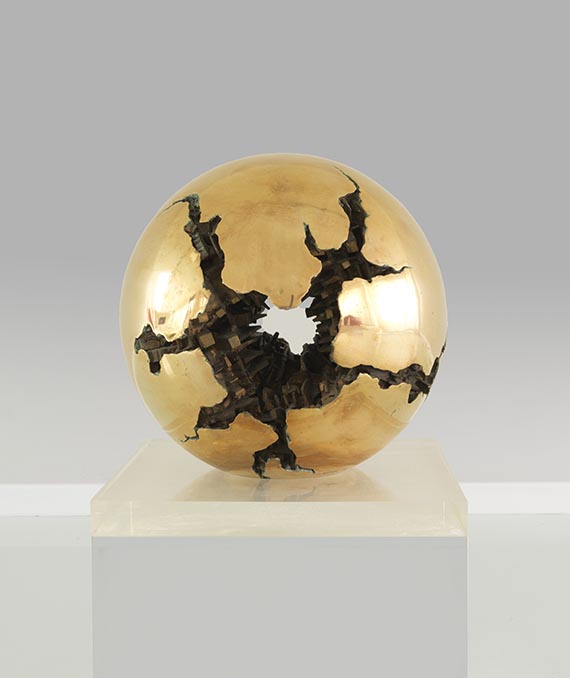
Sfera con perforazione, 1966.
Bronzo
Stima: € 250,000 / $ 280,000
Arnaldo Pomodoro
1926 - 2025
Sfera con perforazione. 1966.
Bronze.
On a Plexiglas base bearing the signature, date, title, and number. One of two artist’s proofs outside the edition of two. Diameter: 57.5 cm (22.6 in). Base: 60 x 60 x 5,5 cm (23,6 x 23,6 x 2,1 in).
[AW].
EXTREMELY RARE Early spherical sculptures from the 1960s are extremely rare on the international auction market.
ICONIC SERIES Pomodoro’s famous Sfere are represented in collections such as the Peggy Guggenheim Collection in Venice, the Vatican Museums, and the United Nations Headquarters in New York.
PIONEERING STYLE As early as 1966, Pomodoro’s fractured sphere foreshadowed a motif that would shortly thereafter also characterize Fritz Koenig’s world-famous sculpture for the World Trade Center.
MAJOR RETROSPECTIVE The Galleria d’Italia in Milan honored the artist on the occasion of his 100th birthday in 2026 with a comprehensive retrospective that also focused on his famous spherical sculptures.
AUCTION MARKET DEBUT One of only two artist’s proofs outside the edition, in private hands for decades.
Accompanied by a certificate of authenticity issued by the Fondazione Arnaldo Pomodoro, Milan, dated October 26, 2026. The work is registered in the archive under the number “AP 269”.
PROVENANCE: Private collection of Ottomar Lampe, Kiel.
LITERATURE: Flaminio Gualdoni, Arnaldo Pomodoro. Catalogo ragionato della scultura, vol. I, Milan 2007, CR no. 389.
Called up: December 4, 2026 - ca. 17.28 h +/- 20 min.
Arnaldo Pomodoro (1926–2025) is recognized as one of the most significant sculptors of Italian post-war Modernism, and his radical approach to form continues to shape 20th-century abstract sculpture. Born into a world scarred by war, he began his career as a stage designer before turning to goldsmithing with his brother Giò. This training in the craft would have a lasting influence on his later work. After moving to Milan in 1954, he made contacts with Lucio Fontana and Alberto Giacometti, which led him to develop a unique synthesis of craftsmanship and cutting-edge design. His sculptures in bronze, iron, or gold attest to a deep understanding of materials and technique, always combined with an almost philosophical reflection on form and destruction.
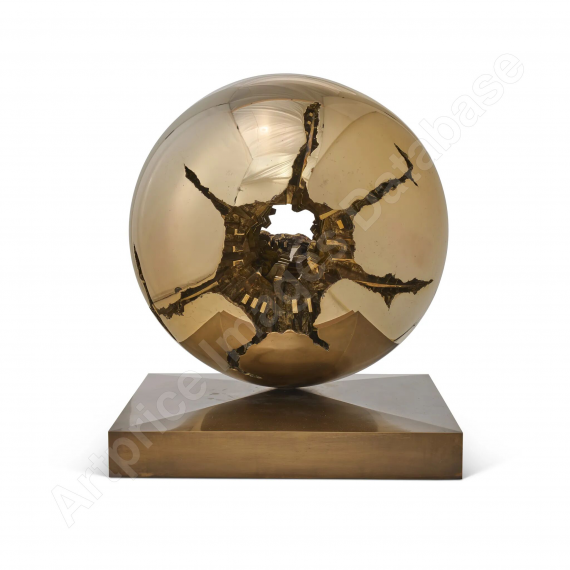
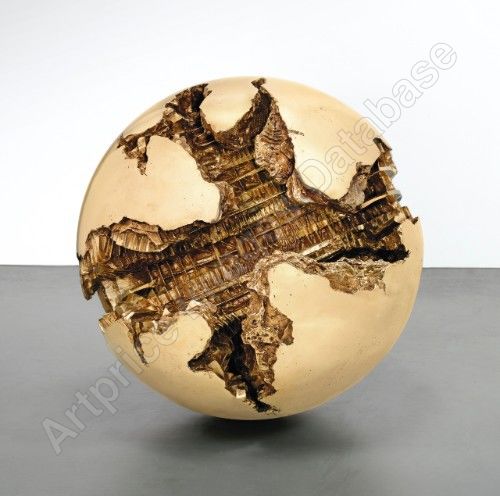
An encounter with Constantin Brancusi’s flawless spheres at the Museum of Modern Art in New York in 1959 was pivotal. While Brancusi embodied the perfect, closed form, Pomodoro viewed it as a challenge: “For me, the sphere is a perfect, almost magical form. Then you try to break the surface, go inside, and give life to the form.” (quoted from: Sculpture: Dissatisfied Aristotle, Time magazine, December 3, 1965) Beginning in 1963, he increasingly devoted himself to spherical forms, yet unlike Brancusi, he broke up the surface to reveal the interior. The sphere became a symbol of the tension between harmony and fragmentation, between organic vitality and mechanical precision. The 1966 sculpture is among the earliest and most fascinating examples of this body of work. The highly polished bronze surface reflects the world around it, while deep cracks and erosions reveal a mysterious interior. A space of interlocking facets opens up, reminiscent of circuit boards, machine parts, or symbols of a lost script. Teeth seem to bite into the void; the interior appears almost organic, almost alive, as if it were pushing its way out of its shell. Through the tension between the presence and absence of form, Pomodoro explores its essence and literally turns the abstract inside out.
“Sfera con perforazione” embodies Pomodoro’s conviction that art must penetrate the surface of things and give form to invisible elements. With its fascinating ambivalence between destruction and creation, between the mechanical and the organic, it exemplifies the artist’s entire body of work. It allows viewers to experience the full depth of his artistic vision. [AW]
Commissione, tassa e diritti di seguito
Quest'oggetto viene offerto con regime fiscale normale o con imposizione sul margine di profitto.
Calcolo commissione particolare sul margine del profitto:
- Prezzo d’aggiudicazione fino a 2.000.000 euro: provvigione del 34%.
- Per la parte del prezzo d’aggiudicazione superiore a 2.000.000 euro si calcola una provvigione del 29%, che viene aggiunta a quella relativa alla parte del prezzo d’aggiudicazione fino a 2.000.000 euro.
- Per la parte del prezzo d’aggiudicazione superiore a 4.000.000 euro si calcola una provvigione del 22%, che viene aggiunta a quella relativa alla parte del prezzo d’aggiudicazione fino a 4.000.000 euro.
La provvigione comprende l'IVA, ma questa non viene indicata.
Calcolo regime fiscale normale:
Prezzo di aggiudicazione fino a 2.000.000 €: supplemento del 29%.
Prezzo di aggiudicazione superiore a 2.000.000 €: Parte del prezzo fino a 2.000.000 € supplemento del 29 %, parte del prezzo che supera i 2.000.000 € supplemento del 23%.
Prezzo di aggiudicazione superiore a 4.000.000 €: Parte del prezzo che supera i 4.000.000 € supplemento del 15%.
L'IVA prevista dalla legge è pari al 7 % sulla somma del prezzo di aggiudicazione e del supplemento.
La preghiamo di avvisarci prima della fatturazione nel caso in cui desidera applicare il regime fiscale normale.
Calcolo diritti di seguito:
Per le opere originali di arti figurative e fotografie di artisti viventi o deceduti da meno di 70 anni soggette al diritto di seguito, in tutti i casi suddetti viene riscossa in aggiunta, a liquidazione della compensazione del diritto di seguito dovuto dalla casa d'aste ai sensi del § 26 della legge tedesca sul diritto d'autore (Urheberrechtsgesetz, UrhG), una compensazione del diritto di seguito con le percentuali indicate nel § 26 2° comma UrhG, che attualmente sono le seguenti:
4 per cento della parte del ricavo della vendita da 400,00 euro a 50.000 euro,
un altro 3 per cento della parte del ricavo della vendita da 50.000,01 a 200.000 Euro,
un altro 1 per cento della parte del ricavo della vendita da 200.000,01 a 350.000 Euro,
un altro 0,5 per cento della parte del ricavo della vendita da 350.000,01 a 500.000 euro e
un altro 0,25 per cento della parte del ricavo della vendita superiore a 500.000 euro.
L’importo complessivo della compensazione del diritto di seguito derivante da una rivendita è pari al massimo a 12.500 euro.